Thursday, October 9, 2008

Scientifik - Criminal (1994)


Classic (though very overlooked) 90s hip hop. Some of the all time best producers on here: Diamond D, Buckwild, RZA, some others. I believe this had real minimal distribution and that it may have not even had stateside distribution at all until like 2 years ago. Dude outta Boston. Just great shit along the lines of CL Smooth and that early 90s east coast stuff. Kinda reminds me a lot of Charizma as well for those who like him. Lots of mystery surrounding dude though, his girlfriend and him were found shot, with the initial idea that he shot her and then himself, but there was never any conclusive evidence. Anyway his two albums were re-released in 2006 and you should probably pick them up, in the last year this has become one of my all time favorite hip hop releases.

Boston area rapper Scientifik recorded at least two LPs in the 90s. But it is Criminal, which was denied a proper domestic release due to industry politricks, that lives on in the boom-bap afterlife of folklore, vinyl bootleg, hissy dub, and mp3 download. Criminal boasts a mid-90s dream team of producers – deities RZA, Buckwild, and Diamond D contribute beats – as well as a tragic, dramatic back story. Police theorize that Scientifik shot his girlfriend to death and then turned his gun on himself in late 1996, but the case is still officially unsolved due to incomplete evidence.

Perhaps unsurprisingly, this record retains a cult following. It ain’t hard to tell why the music is still captivating. On the mic Scientifik is certainly competent, and by 1994 standards he operates correctly, dropping jewelz and relating crime sagas in a soldierly, commanding voice that flexes just enough to reveal his famished intensity. It doesn’t hurt that some of the beats are absolutely tremendous bangers. The mid-album string of “East Coast Jungle,” “I Got Plans,” and “Lawtown” is as good as it gets; each song typifies that ol’ brooding, moody, Gotham City at midnight hardcore rap sound that safe harbor mixshow DJs and their insomniac fans once coveted.

Criminal is a work teeming with skills that successfully panders to the consensus of aficionados; this is the album’s primary strength and its ultimate weakness. Even if we adjust for the era’s overflow of beloved gems and our current nostalgia for the cerebral street music of yesterday, we are left with mega-quality sans distinction. Guest verses from hugely magnetic legends Diamond D and Ed OG only accentuate Scientifik’s dearth of album-carrying charisma. Criminal lacks the dimension and enjoyability of similarly shelved and/or sabotaged mid-90s projects like Jemini the Gifted One’s Scars and Pain, even if its standout songs shine brighter.
-ohword.com

Real In-Depth Review
Buy Here
Download Here

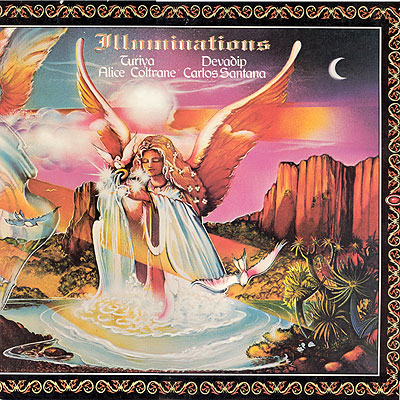
Carlos Santana & Alice Coltrane - Illuminations (1974)


AMG totally slams this record, gives it 2 stars. For me, it's really sublime and beautiful and I bet it would find some fans here. You would think with these two in the early 70s, this record would be really dense and noisy, but it's pretty minimal for the two of them. They are new versions of John Coltrane songs and they sure are pretty.

Of the five albums from Carlos Santana's jazzy period, four can be described as jazz/rock, altho the latter term is sometimes a stretch. Illuminations, Carlos' joint effort with Alice Coltrane, John's widow, cannot be so characterized at all except for one of the four instrumental tracks, "Angel of Sunlight." This jazz/rock fusion, also steeped in raga, is a showcase for the sort of fine guitar soloing expected from Carlos, as well as Santana-style percussion, good bass work, etc. The other three songs are jazz/classical. They are richly textured orchestral arrangements, heavy with sweeping strings arranged by Alice, who herself plays harp and mellotron. Jules Broussard plays flute as well as saxophone. (Where is that Santana percussion section?) Carlos' chief contribution is exquisite, sweet guitar notes, not ripping solos. The result is a majestic, celestial atmosphere, reflecting Carlos' and Alice's spiritual focus of the time. The song titles tell the story: "Angel of Air/Angel of Water," "Bliss: The Eternal Now," and the title cut. This music is not what you normally expect from Santana, but is very pleasant, very lovely, for sure.
-David C. Heires, Amazon.com

Buy Here
Download Here

A Certain Ratio - Early (2002)


I don't know ACR that well, but of the two albums I've heard, they didn't strike me as GREAT. As a collection of good singles or whatever this is much better to me. Basically Joy Division/Factory Records sound but much more NY-disco influenced. It's fun stuff. Plus it's on Soul Jazz Records, so you know it at least sounds good and IF YOU BUY IT it is bound to come with an awesome package.

With the Creation reissues of A Certain Ratio's catalog becoming increasingly tough to track down and with the post-punk revival going on around the time of its release, Early arrived right on time. Despite an uneven discography and an inexplicably numerous string of Joy Division comparisons, ACR was an excellent -- if inconsistent -- post-punk band that exemplified a spectacular movement against the old rock guard. In reality, it only seems right to refer to the ACR captured here as a post-punk band for chronology's sake. They came after the punk explosion of 1977, yet they had hardly anything in common with that movement. At their best, they used rock instrumentation to sound little like a rock band, laying a combination of disco, funk, and Latin percussion as the foundation of their sound. They hardly took a cue from punk, evidenced as early on as their second single, a cover of Banbarra's "Shack Up." Early, an assemblage of key moments and rarities that ends with 1985, is one of those compilations that makes no overt commitment to the fanatic or the curious -- an issue that's probably exacerbated by the inclusion of five Peel Session selections. As a result, four songs are presented in two versions, eating up space that could have been taken up by other highlights. The only case where this overlap can be excused is "All Night Party," their first single; the studio version is a drumless din of Mancunian miserableness, while the Peel Session version is given the death disco treatment with drums from Donald Johnson, who wasn't on board at the time of the song's original recording. It would be a bit of a cop-out on the part of the Soul Jazz label to view the second disc -- the one with the B-sides, rarities, and Peel Session material -- merely as the icing on the cake, the bonus. Though Early goes for the price of a single disc, the space provided could have been used a bit better. The discs are far from maxed-out content-wise, and there are a handful of damnable exclusions. However, this bizarre restraint might have more to do with the future of the ACR catalog than a few boneheaded decisions. All things considered, there is no shortage of great material here, and the packaging is phenomenal. A short film documenting the band's first trip to New York City is also included

-Andy Kellman, AMG

Buy Here
Soul Jazz
Download Here

Lindsey Buckingham - Gift Of Screws (2008)


Always get kind of nervous posting new music but whatever. I'm gonna post up a few albums that I've uploaded for other reasons in the last couple weeks and just forgot to post here. But yeah, this is the new Lindsey Buckingham. It's great. Whereas 2006's "Under The Skin" was bizarre and artsy and stuff, this is just a great pop records. Of course it features Lindsey's signature finger-picking guitar style and his classic vocals. Definitely one of my favorite releases of the year.

Two studio albums in three years may not seem to be a breakneck pace for anybody else, but for Lindsey Buckingham it is no less than pure acceleration. Indeed if we include the live album that came out in 2007 between the two, it's like three outings in as many years -- warp speed for an artist like Buckingham who has been known to go more than a decade between his own offerings outside of Fleetwood Mac. On 2006's Under the Skin, Buckingham issued a soft-spoken songwriter's disc. It was all acoustic, deeply reflective, poignant, profound, and drenched in beauty. It was also criminally under-noticed. Somewhere he promised he'd release an electric rock record in the future. Gift of Screws (referencing the poetry of Emily Dickinson) may not be all the way there, but more often than not it offers the kind of rocking, heady electric pop he's known for, as well as some glorious, lyrically sophisticated, acoustic singer/songwriter fare that bears his signature alone. Some of these tracks were written for an aborted session begun in the 1990s. Still others made it onto the Mac's Say You Will, and still others are brand-spanking new.

The set opens with "Great Day," a pulsing, urgent, minor-key rocker that blends electric and acoustic guitars, organic and electronic percussion, and some hushed keyboards. It explodes near the end with a scorching, burn-up-the-wire guitar solo he usually only plays live. "Did You Miss Me?," written with wife Kristen Buckingham and featuring drums by Walfredo Reyes, could have appeared on any of Fleetwood Mac's blissed-out, bittersweet '70s recordings. The weave of guitars, layered backing vocals, and drop-dead catchy chorus is pure Buckingham. Mick Fleetwood and John McVie are the rhythm section on the rumbling multi-dimensional blues-winder "Wait for Me," which also offers more evidence of the guitar slinger emerging from the shadows to take place center stage before giving way to a dense multi-textured chorus that transcends the blues without leaving them for dead. Fleetwood also adds drums to "The Right Place to Fade," with bassist John Pierce. Acoustic guitars meld enormous power chords and stinging lead fills in a frenetically paced pop song. Along the way, there are hesitant, confessional, acoustically orchestrated songs where the darkness almost swallows the light as in "Bel Air Rain." The wall of strings fingerpicking style adds to the emotional heft of songs like "Time Precious Time," especially as the vocal effects give the sound a nearly three-dimensional quality. The title track is a balls-out rocker that places '60s rave-up garage rock up against '70s glam in a storm of guitars and clattering drums. The closer, "Treason," is a dignified near-anthemic pop song with a gospel chorus that is unlike any song Buckingham's written before and sends the set out in a very elegant and deeply moving way.

What it all means is simple: that Buckingham is not only still relevant, but he's also a pioneer in terms of craft, execution, and production, and has plenty to teach the current generation about making excellent records and never resting on your laurels. Gift of Screws is a standout even in his catalog.
-AMG (Thom Jurek)

Buy Here
Download Here

Sunday, October 5, 2008

Kenny Werner - Lawn Chair Society (2007)


Another recent jazz album. This one is super fun. Out on Blue Note last year, just a nice combination of jazz, funk and weird computerized electro-acoustic sounding mumbo jumbo. Lots of different sounds, but definitely a fun and rewarding listen. And just look at that album cover.

To play jazz, one has to be a complete musician. Requirements: technique, imagination, huge ears, improvisational spark, superb time, and empathy. Jazz is not rife with fakers. As a result, many greats get lost in the fray of musical excellence. Maybe one has been Kenny Werner—and maybe we’ve found him now. Boy, have we.

Aficionados have known him forever. Since the early 1980s, Werner has been playing in fantastic trios, working with the likes of Archie Shepp and Joe Lovano, and becoming a fixture on New York’s jazz scene. I’ve heard him as an intelligent and somewhat indirect player—a guy with a voluminous jazz vocabulary of chords and lines who has neither the blues snap of Wynton Kelly nor the languid lyricism of Bill Evans. But what did I really know? Werner was also a brilliant and deeply rhythmic solo player (check out his set Live at the Maybeck Recital Hall from 1994). Maybe I’d only ever heard a part of his art.

Lawn Chair Society—his first Blue Note record, and his second stint on a major label after a pair of RCAs in the late ‘90s—sets Werner in a new and stunning light. Known as a modern acoustic pianist, Werner does much more than just fool around on a Fender Rhodes on Lawn Chair. Rather, this is an integrated electric/acoustic album that manages not to bury the personalities of its soloists—a rare accomplishment.

The soloists are formidable. In addition to Werner—who improvises only on the acoustic, and with lyricism and wit—the recording features Dave Douglas’s trumpet, Chris Potter on tenor sax and bass clarinet, Scott Colley on bass and Brian Blade’s drumming. Blade brings a unique sound to the disc, never swinging in the straight ahead jazz sense but playing every manner of atmospheric funk pattern, loud and soft, in and out. All the players act similarly as colorists as well as melodists, with Douglas using various mutes and Potter adopting different tones to blend with the electronic environments conceived by producer Lenny Picket for Werner’s compositions. As the players color the pieces, they manage to retain their own voices—Dave Douglas is till piquant and puckish on cornet, Potter jumps and mutters like he is always making a joke, and Colley plays with unparalleled beauty.

Most of the compositions are improved by a well-planned use of electronics. Right out of the gate, “Lo’s Garden” processes percussion through a sequencer of some kind. But rather than being a tune with merely a cheesy fusion-electronica bed, Douglas and Potter (on bass clarinet) play a herky-jerky line that meshes in rhythm and sonority with the groove. Werner’s keyboards are not up front—he always saves the soloing for piano—but they generate pulsations and feeling below the surface. With Colley’s sound always earthy and round, the result is balanced: no fusion flash or smooth goopiness, just a single-minded approach to a fascinating tune.

“Lawn Chairs (and Other Foreign Policy)” integrates acoustic and electric differently but just as well. Though it begins with a hip acoustic piano rip, it then moves into a ragtime-ish keyboard groove that Douglas plays over as if he were some kind of doped-up Louis Armstrong—growling, smearing, and diving for fun with a touch of Miles-ian echo. The two horns then play a line that becomes the ground rhythm as percussion and bass enter. This gradually morphs into a piano solo with traditional acoustic accompaniment, winding up eventually in a Rhodes-and-organ-saturated groove that directly references In a Silent Way. It’s marvelous, however, because each of these transitions is achieved with slight-of-hand. The tune feels complete.

The highlight for me is the astonishingly direct and emotional song, “Uncovered Heart”, written 16 years ago at the birth of Werner’s daughter. The synthesized content is limited to subtle string pads, with Werner playing a Jarrett-like open style that emphasizes rhapsodic melody. After Werner states the simple tune in two choruses, the horns play a variation as introduction to a smashingly plain and lovely bass solo. When Werner solos it is equally elegant and elegiac.

It makes sense that “Uncovered Heart” should be the album’s showcase, as Werner’s daughter, Katheryn, was present for the recording but died in a car accident before the album’s completion. “Loss”, a short, synthesized orchestral piece that likely refers to Werner’s terrible loss, leads the album back to a bass line similar to that of “Uncovered Heart”, which then leads into the album’s only cover, “Kothbiro”. Another highlight, this tune moves with inevitable and stately grace. Werner’s solo is stripped of all clichés, and the trading of statements by Douglas and Potter is the kind of plainsong that jazz always needs more of. Werner—knowingly or not—has created a substantial monument to his love for his daughter.

If I have failed to write about the adventure of Chris Potter in mid-thought or the flash of Brian Blade when he is fused with the piano vamp on “Inaugural Balls”, it is only because Lawn Chair Society is such a thoroughly integrated recording that it tempts the listener to forget its flashiest moments. “Balls” bustles into a brilliant collective improvisation fueled by organ swells and pure Blade hipness. “New Amsterdam” gets started with a Herbie Hancock-ish gospel groove that is jagged and funky at once, with Colley latching it all to the dirt. These tracks are propulsive and meaty just as “Uncovered Heart” and “Kothbiro” are infused with legitimate sentiment. The balance in it all—electronic whooshes meshing elegantly with skin on ivory—is the record’s ace in the hole.

The closer you listen, the higher Kenny Werner’s Lawn Chair Society will rise on your year’s-best list. Firm and delicate, electric and acoustic, gentle and daring, it does with nonchalant ease what 30 years of “fusion” has done so rarely: keep jazz both serious and modern as it integrates the possibilities of new technology. Suddenly, Kenny Werner (along with producer Lenny Picket) is a jazz master and maverick—a veteran artist whose voice has come alive on a big stage.

Pull up a lawn chair and check out Kenny Werner. His time has come.
-Will Layman, Popmatters.com

Download Here

Saturday, October 4, 2008

Esbjörn Svensson Trio - Leucocyte (2008)


I don't usually post new albums, but I thought I'd make an exception today and we'll see what happens.

So i spent a good part of today downloading and looking at some jazz releases from this year because I hadn't really been paying attention. I went to look up what EST had put out this year, only to be shocked that Esbjorn had died in June and here I am 4 months later and didn't even know. Awful. Truly awful to lose such a talent and someone who has been consistently putting out great records and really keeping modern jazz exciting. This trio is basically the biggest European name in progressive jazz in the last few years, and were the first European band on the cover of Downbeat magazine last year, I believe. Anyway, I've liked all the albums I've heard of theirs, but this one blew my mind. The first six tracks are sort of all over the place, but still flow really well. The "Premonition" tracks are great, and the ones that follow are more based in jazz. The album closes with a suite named after the album, and it is experimental and really cutting edge and exciting. A really engrossing record that is out there, but not necessarily by being really loud and abrasive (though it is not subtle either). Definitely one of the best "first listen's" of a new album this year. Highly recommended.

Considering that this is the last we will ever hear from the wonderful e.s.t (pianist Esbjorn Svensson having tragically died in a diving accident earlier this year, at the age of 44) it's impossible not to feel sadness while listening to Leucocyte. Yet it's not for just the passing of one of the world's most talented jazz musicians. It's also for the fact that a band, so psychically linked and at ease with each other should, at this fascinating stage of their development, be robbed of the chance to grow and change as they undoubtedly would have done.

Composed of childood friends Svensson and drummer Magnus Ostrom, along with bassist Dan Berglund, e.s.t's last album, Live In Hamburg, seemed to be drawing a line under the ECM-friendly-with a-touch-of-rock-trio period of their career. Equally at home on the festival as well as jazz circuits, you could feel it was time for a change.

Leucocyte reminds you that, despite carrying the pianist's name, the trio were a band of equal thirds. It's Berglund's earthy tones that drive much of the first half of the album. Following the delicate introductory meditation, Decade, Premonition sounds hungry for just such a change. The feedback and distortion are comparable to Australia's Necks, but under it all Svensson's voice echoes the changes, and his keys can never resist the Jarrett-esque flourishes that trip lightly over the atmospherics. Not once does the soloing take the place of progression and thematic exploration. And the attack always veers towards that rock aesthetic that rears its head most ironically on the number entitled Jazz.

But it's the album's second half suite, Leucocyte, that indicates where the trio were headed next. Mixing in far more electronics; erasing melody, leaving just the warp and weft of instrumental texture, and even (on part two's Ad Interim) resorting to total silence: it shows us a band that were now fearless and confident enough to really experiment.

Leucocyte is far from a perfect album, and that's why it's so heartbreakingly good. It's unsure in parts, and occasionally too wilfully rough. But it's a pointer to a future that's been cruelly denied us. We can only dream of what might have happened next. But thank goodness we have this to remember Svensson by. It's a testament to an artist whose life was always a work in progress.

-Chris Jones, BBC

Download Here
Buy Here

Wednesday, October 1, 2008

Blind Boy Fuller & Sonny Terry - Harmonica & Guitar Blues 1937-1945


Just a real great classic blues collection. Been a fan of Blind Boy Fuller for a while, and had some Sonny Terry songs here and there, but together, this compilation is just like the perfect blend of badass old country blues. Just get it if you are a fan of old blues because it's great.

Download Here