Showing posts with label 70s. Show all posts

Tuesday, March 23, 2010

A To Z: King Biscuit Flower Hour (Live 1976) - The Band


If THE BAND were any other band, their name would be audacious, obnoxious and forgettable. As it turned out, The Band aka The Hawks deserve the title of THE quintessential group of musicians and calling themselves THE BAND is as fitting a title as any.

I've loved The Band since high school. I'd seen The Last Waltz, more for the other musicians involved than The Band themselves. I found an old copy of their self-titled second album at a garage sale among the first week or two that I started collecting records. I knew "Up on Cripple Creek" and "The Weight" and a couple of other songs before I knew who sang them. I didn't know their story and I was hardly even into Bob Dylan at the time, but The Band was something special to me in those formative years.

Or rather, I claimed them to be.

After my initial exposure to The Band, I loved a handful of songs and appreciated what they were doing but I didn't really get it. I knew liking them was cooler than liking CSNY or CCR or other similarly styled bands that blurred the lines of rock, country, blues and folk. These scraggly dudes were accomplished musicians, that is what the internet told me. Robbie Robertson was one of the best songwriters of his generation, or so I heard. It took me years to finally succumb and agree.

This radio broadcast recorded live in 1976 isn't the best live document in The Band's catalogue, but for my money nothing they ever performed live was bad. It's good for a bootleg, but not the best audio quality ever. There is some major riffs and solos, but few instances that show what these musicians are actually capable of. The organ on this recording seems louder than actual studio albums which gives the songs a bit of a unique sound. They perform the songs you know, maybe some you don't. Good overview but no Last Waltz.

If you are a fan of The Band though, you should probably have this.


This is from The Last Waltz, but it still gives me chills, so I included it.

Download Here

Saturday, March 20, 2010

A To Z: Journey In Satchidananda - Alice Coltrane


When you listen to a lot of different avant-garde jazz releases, you have to mentally prepare yourself. You don't listen to Cecil Taylor or Albert Ayler as background music. You don't put "Interstellar Space" on and just go ahead and do the dishes. Free jazz, spiritual jazz, vanguard jazz, this is is music literally created to combat the passive and often dismissive nature of people wanting to "listen" to jazz. With a notion of jazz being for the beatniks and the coffee shops, the idea was struck down quickly by these very masters - finding new ground in the same way that many psychedelic rock bands were allowing hippies to reach higher astral planes.

Alice Coltrane fits in with these masters perfectly. She created difficult music with her husband before his untimely death, and made a career of perpetuating different experiments that crossed various genre lines. However, with "Journey In Satchidanda", you don't have to mentally prepare yourself for the listening experience. It's not grating, it's beautiful. And regardless of where you are, it will pull you in. It works as both background music and as one of the most engaging listens in your library. It's a crossover record in the most personal way. And it gets better every time. Of all the spiritual jazz pioneers, perhaps none were quite as spiritual as Alice.

Oh and she plays the harp.

Alice also employs the piano in her repetoire, and on this album is joined by two of my favorite musicians: Pharoah Sanders on soprano sax and Charlie Haden on bass. These three create a dynamic nucleus that is engulfed by the constant drone provided by middle-eastern instruments the oud and tamboura. There have been many attempts at bridging traditional middle-eastern or indian instruments with western jazz music and I will say right here: "Journey In Satchidanda" is likely the best.

This is the rare album that expands the loose definition of jazz yet remains an accessible album. For those who like traditional jazz numbers or the lighter side, they are unlikely to feel too alienated with this release. For those who only like jazz that transports them places, that takes a while to understand - they will feel right at home here too.

The beauty this record can stop you in your tracks. It can cause obsession. It truly is a "journey".


Download Here

Sunday, February 28, 2010

A To Z: Heart Food - Judee Sill


There are certain musicians who can take pop music and completely flip it on its head. Brian Wilson's "teenage symphonies" were extra lush song cycles meant that somehow appealed to the rock and roll crowd more akin to liking two-and-a-half minute standard pop tunes. Prior to Brian Wilson and his brothers, Phil Spector created the now infamous "wall of sound"- literally throwing everything into the mix that his recording capabilities could handle. Despite the noise, the songs maintained a feeling of completely literate, interesting and downright intelligent pop music. The Ronettes were making music for high school dances, yet there was artistry there. We can go through every decade of pop music and find specific examples of musicians and bands (and perhaps more appropriately, producers), whose knowledge of what pop music can and should be has constantly pushed the envelope. By synthesizing the best parts of different subgenres of popular music, many of our greatest artists are just that because somewhere in their career they put out music that was unheard of before then. Something new, something unique and ultimately, something that has a lasting impact on the listeners, who find meanings through the sheen of pop and obsess over the music in their own ways.

I've heard the name Judee Sill for years. I'd seen her two albums talked about many times throughout my forays and obsessions into the world of 1970s California Folk Rock. It wasn't until recently, however, that I finally took a chance at giving Judee a listen. Imagine my surprise when I heard music that could be likened those late 70s Beach Boys recordings (my favorite), instead of what I expected to be a mediocre Joni Mitchell or Carly Simon carbon copy with some heart-on-the-sleeve lyrics.

On Heart Food Judee Sill created what is one of the most unjustly unheralded achievements in all of contemporary folk music. Everything is based primarily on guitar and piano, but other stringed instruments get added to the music, giving her otherwise personal and intimate songs a grandiose sense. Sill's singing has a unique quality, often starting her verses at a quieter, softer timbre before barring her teeth and singing as though she has a case to plead to God.

In fact much of the album has religious conotations, references to God and spirituality without being overly zealous. The comparison to Brian Wilson applies in this aspect as well. Story-like lyrics that reference a troubled soul, allowing herself to breathe in the only way she knows how: creating beautiful music.

It's a shame that Judee Sill's Heart Food isn't considered by more to be one of the best records of its time. It's a record unlike any others. It's clearly folk music, but it's clearly pop music. References could be drawn, similarities between Judee and other artists could be attempted, but Heart Food is a record that is all it's own. A record of epic scope, rooted in the most minute details of the artist's voice.


Download Here

Monday, February 15, 2010

A To Z: Freedom Flight - Shuggie Otis


What did you do when you were 18?

When I was 18 I graduated high school without a desire in the world. I worked my first real job - getting my hands cut up by sheet metal, my lungs filled with asbestos and my hair filled with fiberglass filaments. I started college, or rather, attended classes at a university for a quarter before transferring to a community college that offered me nothing more than the high school I had just left. I lacked motivation, the most creative thing I did was write my 2nd of what has become 7 "Top 50 Albums of the Year" list, in which I claimed Madvillain to reign supreme.

When Shuggie Otis was 18, he released what has become what I consider to be one of the most complete albums of the 70s and perhaps one of my very favorite releases of all time.

At it's heart, Freedom Flight is a blues album - but unlike those albums that came before it, it is a blues so forward thinking without sounding entirely alien, it is hard to pinpoint influences or relatable musicians. Blurring the lines between psychedelic, orchestral pop, floor-stomping blues, Hendrix and jamming in a sundazed haze, Shuggie presents 7 tracks (plus a bonus cut) ranging from lengths of 2:30 to 13:00. The longer tracks that close out the album, "Purple" and "Freedom Flight" might very well be the best instrumental rock songs to have come out by this time on albums that were not completely instrumental.

Shuggie's guitar playing is essential listening. You can hear influences of Santana and other Woodstock luminaries in his plucking, but perhaps the most striking thing is the direct line you can draw from many of his licks to some of Prince's best moments (and yes I know they look alike). Shuggie will almost certainly be remembered as the kid who wrote "Strawberry Letter 23" which was later popularized by The Brothers Johnson or maybe he will be remembered as the guy who put out Inspiration Information a few years later, inspiring many of the best musicians and jazz groups of the next 20 years. Despite this and despite the legacy of influence that Shuggie has left in his short career (he hasn't recorded much over the last 30 years), I honestly think that Freedom Flight is his most important moment. It's an album that says "hey I can do what you do better than you can, and check this out too..."

Freedom Flight is a treasure of an album, and a vision rarely matched.


Download Here

Saturday, January 30, 2010

A To Z: Doremi Fasol Latido - Hawkwind


1972 is an absolutely incredible year in music history. I cannot help but think what it would've been like to be the age I am now back then. Where would I have stood musically? Would I find myself part of the increasingly popular Glam Rock scene? Would I find myself with long hair and a hog, listening to Deep Purple? Would I be at crux in my life - rejecting traditional rock n roll for the likes of the classical influences inherent in Progressive Rock? Could I be cool enough to have connections to people following the apex of the Brazilian music scene? Maybe I would just be listening to the popular stuff by Elton John, Paul Simon, and Stevie Wonder.

37 years past that particular year, I find myself wanting to be a part of all these scenes, loving many albums released during this year retrospectively. I have no context of what it would have been like to actually have BEEN THERE. I've seen concerts, I've read anecdotes, I'm jealous to not have lived through this time, just as I'm jealous to not have lived through any significant time in pop music history.

As a natural extension and rebirth of the hippies at the end of the 60's, perhaps the burgeoning Space Rock, psych folk, Glastonbury scene would've been the scene for me. These people held true to what they wanted to do, mixing pop, rock and electronics to create music that was similar to that being created in Germany at the time - but distinctly different.

The difference was Hawkwind.

Doremi Fasol Latido came out on the heels of the massive UK single "Silver Machine" - a song that was not found on any Hawkwind album at the time, but still featured a sound that would soon define them. Lemmy's vocals sound like Roger Daltry, the guitar and bass chugging is reminiscent of the heavy rock found in Uriah Heep and Deep Purple - yet there was this ambience added to the music. A constant humming sound that gently slid up and down the scales, not distracting from the music but definitely noticable. Imagine your rock band performing in the middle of a hurricane, attempting to send it back from where it came. You get the point.

Doremi was 7 tracks the first time it was released. Alternating between hard rock, proto punk, kraut rock, and a handful of British folk moments - many consider this their masterpiece.

I've never really understood the genre title of "Space Rock" beyond the occasional synthesizer whirlings. To me, I think of the serene, minimal, bleep blopp fizz captured perfectly in the soundtracks to movies like Solaris, Moon and Sunshine as something "true" to space. I see The Orb as much more indicative of the loneliness I imagine space to be rather than what Hawkwind present it as.

A party. A huge, drug-fueled, week-long, awesome party.

If those soundtracks (or even perhaps the 2001: A Space Odyssey score) are what I imagine the true sound of space to be like, Doremi Fasol Latido is the quintessential soundtrack for teenagers traveling to space in rebellion against their aging parents. You see, there is a sense of urgency and defiance found throughout the album. The guitar is harsh, the recording is shit and everytime lyrics and singing are introduced I can't help but feel that Hawkwind is trying to write some melodramatic space opera.

But the drawn-out, mind-melting, feedback laden instrumental passages rock. This isn't space music to float around to. This is the your soundtrack to conquer space.

It's not a perfect album, I don't think it's even the best Hawkwind album, but it's fun to pull out every now and then and listen to loud. Grow your hair out, put on some bizarre threads. Hell, paint your face if you must. It might not be your version of space, but it's theirs. And it is one hell of a fun vision to have.

Download Here

PS. Album includes 4 bonus tracks - none of which I find as good as the any of the preceding 7.

Thursday, July 23, 2009

Tweed - Fashion EP (1979)


Here's one I've been meaning to post for awhile. Semi-legendary 3 track EP from obscure French power pop band. I don't personally have any information on the band, who they are, what they did, why they stopped making this awesome stuff. All I know is that this is the only EP you can really find anywhere (you would have to really scour eBay and record collectors). I believe they have an earlier EP, but I guess they are just known because these songs have appeared on Power Pop comps and mixtapes for decades.

3 songs, all just over 2 minutes. The songs are great, you can listen to them over and over. My favorite is "I Need You"

Music speaks for itself, but you probably need this.

Download Here

Thursday, July 2, 2009

Terry Reid's First 3 Albums

The story goes something like this: Terry Reid was still a teenage guitar player making waves in England. Proposed to be one of the next big things at the end of the 60s. By 18 or 19, Jimmy Page approaches him with an opportunity to sing for "The New Yardbirds." Reid declines, possibly for personal reasons or possibly because he was the opening act on a Stones tour. Reid tells Page he should pursue drummer John Bonham and vocalist Robert Plant. The New Yardbirds become Led Zeppelin, Terry Reid stays a solo act. Later in the 70s, Reid is approached to be the new vocalist for Deep Purple, declines and that title goes to Ian Gillian.

Is Reid the ultimate failed opportunist? Possibly. But at the end of the 60s, and into the 70s, the young Terry Reid put out some pretty excellent rock n roll.

The funny thing is the direct reference point to Terry Reid is probably Robert Plant. Especially his first two albums, and especially when the music turns a bit more to the folk-side of things. Otherwise, he has a high voice but not near the shrieking of Plant. Solid proto-hard rock. All albums are good, none are all-time greats, but the self-titled just misses. Make sure to watch the Youtube performance from 1971 (Glatsonbary Fayre DVD) that is one of the most badass performances there is.

Bang, Bang You're Terry Reid (1968)

First album proper. Some excellent guitar playing, but a number of throwaway cuts. Still sort of establishing his sound.
Download Here

Terry Reid (1969)

Almost certainly his best album. Good material, awesome jamming, great mixture of the harder sound and the folky stuff. Really solid.
Download Here

River (1973)

A looser affair. Definitely sounds like a rock album from 1973. A little more blues influence, a little tropical rhythm here and there. Also a really good album. Not quite as raw as the s/t, but at 7 tracks it's a solid listen and good for these hot summer months.
Download Here

Live Performance of "Dean"-1971

Wednesday, July 1, 2009

Caetano Veloso - Cinema Transcendental (1979)


It's almost pointless to post Brazilian albums on this blog when the powerhouses known as Loronix and Um Que Tenha exist, but I'm posting this anyway.

I've been listening to a lot of Brazilian music lately. I mean, I'll never be able to even really dent the surface in a music scene that certainly rivals (if not overpowers) the pop domination of the UK and US, but there are obviously those few choice artists that get recommended time and time again and my collection has been growing of the last half-decade.

This is a new acquisition for me. Caetano was the first Brazilian musician I became semi-obsessed with, a few years ago. I have about 14 of his albums (including his great 2009 release Zii e Zie), but somehow I had overlooked this one. It generally seems to be regarded as one of his transition albums. AMG calls it his final "quasi-acoustic" album in which he transitioned from the folky, serene singer of his early albums to the more bombastic instrumentation found from the 80s onward.

I love this album.

Though the classic Caetano album is typically considered to be Transa and his self-titled albums, many of his biggest hits in his native Brazil actually came from this album. It's not hard to see why. In some ways, the album cover says it all. Relax, become lost in the music. It's not necessarily background music, it's way too engaging for that, but there is something about Caetano and his Brazilian contemporaries that allow for their brand of pop music to enlighten the listener. I listen and I relax. I may shuffle my body, I may nod my head, I may try to sing along to the choruses in my best Portuguese imitation, but through it all I will somehow manage to feel this unavoidable joy and ease. It works as a collection of single songs, it works as an album. I'm not going to call it my favorite Caetano album, but by the end of this summer it may be very close.

Download Here

Thursday, May 7, 2009

Linc Chamberland - A Place Within (1977)


I'm on a roll right now, watch out.

So I definitely can't take credit for this album or anything about this musician because I just downloaded this from one of my favorite music blogs on the web: My Jazz World. That site is awesome. Super rare funky jazz and shit primarily from the 70s. Lot of different styles thrown into the mix, some are pretty bad, but guy running it, Smooth usually comes correct. This is definitely one of those occasions.

Obviously I downloaded it because of the album cover. Look at this Rasputin ass dude who looks like he should be playing british folk or something. This is actually just excellent late 70s jazz. Linc is the guitarist, but the album is full of badass sax, bass and drum solos as well. Got a scan from the blog of the record sleeve, so I'll type up the liners because that's what I do:

It's been some time since the jazz guitar was freed from the rhythm section and allowed to become the creative, improvising instrument its potential warranted. What Jimmy Blanton did for the bass, Charlie Christian did for the guitar and his efforts helped to create a whole nation of plectrum devotees. We are now faced with a generation that can embrace folk heroes, men as diverse as Jimi Hendrix, Larry Coryell and Jim Hall. The guitar has become a symbol of protest and liberation. Its six strings hold the key to fame and fortune, a chance to see the world on three chords a day. The least skilled practitioners are frequently the most successful. Today's garage rock band can be tomorrow's mascaraed superstars. The flash and the wah-wah pedal can overshadow a brilliant technique.

There have been plenty of spectacular near misses. George Benson's brief fling with Miles Davis was fascinating and hinted at greater things that never materialized. Wes Montgomery was asked to join John Coltrane but the connection was never made. One can only imagine the fireworks had Charlie Christian survived.

The release of this LP helps to insure that a great talent does not get overlooked. Linc Chamberland has been playing the guitar for over twenty years and this is his first record as a leader. If justice is to be had, his name will soon be listed among the greats of the instrument.

I first stumbled upon Linc at one of his Tuesday night Rapson's gigs in Stamford, Conneticut. I had long heard of him from admiring friends who couched there descriptions in adjectives fit for "the one that got away." Rapson's is a tiny club but it was packed like Reveren Ike's sermons the night I finally made it down. There was a devoted hush in the room that is all too rare in nightclubs. Linc entered, a black bearded intense looking fellow in his mid 30's, and soon proved the rumors correct. Notes and ideas flew so fast that it was hard to believe they were issuing from the man on the stool in the corner. I recall a version of Chick Corea's "500 Miles High" that continued for 30 minutes and threatened to levitate the room with its intensity. All this achieved without attachment, pedals, or gimmicks of any kind and only a small amplifier to project that incandescent sound.

Much time has passed since that night and now Muse Records is as excited as I am about Linc Chamberland. This record is his own story, told in his own term. The music is not unlike what transpires still at Rapson's. It is pure, honest, and refreshingly alive.

Linc, of course, did not emerge fully formed. He is a native of Norwalk, Conneticut and still lives there. The guitarist admits to first picking up the instrument because he "wanted to be a singing cowboy." He joined his first group, "The Rhythm Chords," when he was 15. This led to a lengthy stint with an R&B big band known as "The Orchids" that yielded one album and a chance for Linc to hone his writing and arranging skills. This band toured almost constantly, a fact that explains Linc's current reluctance to travel. At one point, this band was reduced to eating mustard sandwiches in Hawaii no less! Other groups followed with some fairly unique names: "Gasmask," "Gotham," and "Sawbuck." Linc began to put in a lot of studio time and worked with the jazzy version of Felix Caviliere's "Rascals" (Alice Coltrane, Joe Farrell, and Richard Davis were also along.) Lic started playing at Rapson's soon after and says the long running gig has "helped me find out a lot about myself."

Linc now makes his living from teaching. His reputation is deservedly strong: Charmberland alumni perform with Alphnse Mouzon, Judy Collins, Wishbone Ash and (believe it or not) Alice Cooper. He has over 40 students and finds the work "a constant creative challenge."

The musicians on this album are veteran associates of the guitarist. Lookout Farm leader Dave Liebman has been a regular Rapson's jammer. Australian Dr. Lyn Christie (a medical doctor in addition to his bass talents) only recently left the Chamberland fold and the young Bobby Leonard is Linc's current drummer.

An attempt to get Linc to talk about his music drew a dismissive wave. "It speaks for itself," he said, and indeed it does. I can only call attention to some highlights: Liebman's possessed soprano on Lyn Christie's "Place Within," Christie's tense, brooding arco bass on Chamberland's "1957" and Leonard's sensitive accompaniment on the trio feature "What's New." Chamberland's guitar holds it all together with rhythm playing that offers firm footing and solos that just don't stop. The music offers no compromise and holds back nothing.

Dave Liebman tracked down in Wethersfield, Conneticut, offered the following assessment of Linc: "He's a great musician and a fine human being." Further elaboration is unnecessary. Listen to the record.
-Jim Motavalli

Download Here


Alfred Schnittke - Violin Concertos No. 3 & 4 (1991)


The second set of Violin Concertos from 20th century composer Alfred Schnittke! Look, two posts in two days and about 12 hours! Got the liners on this, so I might as well...

Concerto No. 3 for Violin and Chamber Orchestra (1978)
This work was originally intended to form part of a programme in which Hindemith's
Piano Concerto and the Chamber Concerto of Alban Berg were to be played. This determined the orchestral forces of my piece, which sum up those of the other two pieces but which also influenced the sound concept of my concerto: thirteen wind instruments and only four strings produce an inequality of weight. I found a solution to this problem in saving the strings for the third movement, where they enter for the first time and replace the wind sound towards the end of the composition.

The title original planned,
Canticum canticorcum, which I eventually renounced since I am against programmatic explicitness, found a certain reflection in the concerto's musical language (for example, in the soloist's initial cadenza). But there are also quite different influences at work - those of Russion Orthodox church music (in the final chorale of the first and third movements) and German Romanticism (the forest music at the beginning of the third movement which, despite the horn fifths and fluctuations between major and minor, is not a quotation from Schubert or Mahler). And the atonal idiom also leads naturally on occasion to twelve-note themes, but never to twelve-tone rows. the combination of these tonal spheres is not subject to any constructional principle: I merely followed my ear's commands.

I have long been preoccupied by the opposition of the tonal and the atonal. In this work I tried to construct a unified system of intonations linking the two soundworlds organically - that is, not only through the contrasting effects of night and day but also by means of the morning and evening transitions and the ever-present play of shadows and colour modulation. Atonality can be reached from any point in tonality (and vice versa).

The
Violin Concerto's three movements follow the scheme of double contrasts (slow-fast-slow) and are played without a break. The solo part makes no virtuoso demands on the soloist and is predominantly melodically conceived. The first performance took place January 1979 in the Great Hall of the Moscow Conservatory.
-Alfred Schnittke

The meeting and co-existence of a variety of forms of musical material, a variety of worlds of style and imagery - these probelms are central in Alfred Schnittke's
Third Violin Concerto. The orchestral forces are similar to those used in Alban Berg's Chamber Concerto for violin, piano and thirteen wind players (1925). Additionally there are four string players, whose entry marks the beginning of the finale, of the illumination and alleviation of the general atmosphere.

The three movements of Schnittke's concerto are there different stages or aspects of one idea. The first movement, emerging from the soloist's tense trills, presents the 'prehistory', as it were. Here one may discern the most important spheres of imagery in the concerto: firstly the intensively expressive, tauntingly enraged, dissonant structure of intervals which serves as the point of departure for the rebelliously unbalanced second movement; secondly the light and conciliatory major/minor flickering of triad runs, which finally becomes decisive in the finale; and finally the strict chorale, the most important of the elements, which concludes the flow of events like an epitaph.

The second and third movements merely develop the 'theses' of the first; they unfold a temporally calculated concept. The strongest contrast arises before the beginning of the finale: a storm-wave of contradictions and passions crashes down in an aleatory culmination; the musical material shatters into the tiniest fragments. And here, amidst the catastrophe, like an illusion of ghostly harmony, horn fifths suddenly appear - in the music of past centuries the frequently-occurring symbol of problems happily resolved. The sound here is devoid of the unambiguity acquired through the centuries; doubt shines through the major/minor play of light and shadow...The tide of music finds no rest; it hurries on into the depths of centuries, eventually finding its hold in a universal, eternal symbol: the chorale.
-Alexander Ivashkin

Concerto No. 4 for Violin and Orchestra (1984)
My Fourth Violin Concerto, a commission from the Berlin Festival, is dedicated to my dear friend Gidon Kremer, as a sign of my great admiration and most heartfelt thanks. Gidon has contributed decisively to the spread of my works, both through countless performances and also by inspiring and stimulating other musicians. For this reason the musical material on this four-movement concerto is taken from monograms of Gidon Gremer and of myself - and in the last movement also of three other kindred souls, Edison Denisov, Sofia Gubaidulina and Arvo Part. It is not, however, a constructed Babel (except for the perpetuum mobile passacaglia in the second movement); rather it is an attempt to create a melodic tension both between one note and another and also between notes and rests, with free application of techniques both 'new' and 'old'. Two beautiful plush melodies (the first running through the entire piece as a fatum banale, the second appearing as a false relief in the third movement) are merely two 'corpses decorated with make-up'. On a few occasions (for example the 'cadenza visuale', second movement) a peep is ventured behind the curtain into the soundless, hypnotic music Hereafter - into the world of silent sound (otherwise called 'rest'). But these are only moments, brief attempts to fly; the foundering descent back into the world of sound is inevitable. Or is it?
-Alfred Schnittke

The
Fourth Violin Concerto dates from 1984. The concerto is unquestionably one of Schnittke's preferred musical forms. The previous violin concertos had demonstrated quite different compositional methods on Schnittke's part. This piece confirms his path towards greater simplicity, towards love for tonal, extremely straightforward musical figures. A large romantic orchestra is required, reinforced by instruments of striking sonic character such as the saxophone, the felaxatone (usually confined to lighter music) and most especially by an unconventional battery of chord instruments: xylophone, glockenspiel, marimba, vibraphone, bells, celesta, harpsichord and piano. Schnittke employs these last-named instruments principally for the support and coloration of static textures. The idea of a colossal Basso continuo, the chordal accompaniment of baroque music, must have been determining significance in this respect.

The
Fourth Concerto has four movements. The sequence Andante-Vivo-Adagio-Lento makes it plain that a measured and well audible tone takes precedence over virtuoso passages. Right at the beginning of the first movement, important structural elements are presented. After a reverberating bell motif we hear a peculiarly plain, warm theme in A flat major, its instrumentation rather gentle and peaceful (woodwind and horn). With its tonic/dominant exchange it is intentionally trivial, like an exponent of another, lost musical language. The solo violin tries to attune itself to this, but upon its entry the veil of comfort is torn aside. A dissonant chord, including all twelve notes of the tonal system, is rudely inserted; the violin continues the melodic development with a harsh friction of semitones and broken chords. The mood only brightens when the violin takes up the opening bell motif. The plain theme then occurs once more, this time in C sharp minor, and - richer, as it were, in experience - shot through with distracting notes. The first movement concludes with the return of the bell motif, this time over a dissonant, static string structure.

This movement has not only seen the exposition of the musical material but also the erection of the compositional principle: the zones of insecurity lurk behind apparently tranquil beauty. The entire concerto is to be understood in this light. The lively second movement is basically one large cadenza over intricate broken chords from the soloist. At the movement's climax, with ever more rugged breakings, the tone of the soloist becomes more and more 'faded out' - Schnittke calls this a 'cadenza visuale', with the utmost passion but almost devoid of the means to express it. Only after a grandiose entry by the previously silent strings on the note G (the lowest note on the violin) does the soloist regain his tone - but at this point the movement breaks off. The remaining two movements advance other attitudes, stated at their respective outsets, onto a higher plane. In the third, the destabilization of an emphatically beautifully conceived melody is driven forwards; the fourth returns to the serene peace of the bell motif from the beginning of the work.
-Dr. Reinhard Schulz

Download Here

Monday, April 27, 2009

Don Ellis - Tears Of Joy (1971)


This is for the comments in the previous post. Great record anyway. Was thinking about posting Don Ellis' soundtracks to the French Connection movies sometime soon, so the post actually works. Outstanding album (double album!) from crazy ass Don Ellis. Haven't actually listened to this for awhile, so I'm gonna bow out to an AMG review:

Recorded in 1971, Tears of Joy is a Don Ellis classic. The sheer musical strength of this ensemble is pretty much unparalleled in his career. The trumpeter/leader had backed off -- a bit -- from some of his outlandish and beautifully excessive use of strange and unconventional time signatures, though there is no lack of pioneering experimentalism in tone, color, arrangement, or style. This double LP/CD features a string quartet, a brass octet (four trumpets, tuba, bass trombone, trombone, and French horn), four winds, and a rhythm section boasting two drummers, a percussionist, a bassist, and the Bulgarian jazz piano wizard Milcho Leviev. This is a sprawling album. Disc one is made up of short- to mid-length pieces, the most notable of which are the intense adrenaline surge of "5/4 Getaway" (with a killer string arrangement by Hank Levy, one of three arrangers on this set) and the blazing Eastern European klezmer meets Bulgarian wedding music meets hard bop blues of "Bulgarian Bulge." Leviev's solo on the latter comes right out of the knotty, full-on bore of the tune's melody (written by Ellis, who scored all but three selections), and cites everyone from Wynton Kelly to Scott Joplin to Mal Waldron. Elsewhere, such as on "Quiet Longing," the strings are utilized as the base and texture of color. One can hear Gil Evans' influence here, and in the restrained tenderness of this short work one can also hear Ellis' profound lyricism in his flügelhorn solo. The second disc's first moment, "How's This for Openers?," is a knotty composition that touches on bolero, Aaron Copland, and operatic overture. Levy's "Samba Bajada" is a swinging opus that uses tropes from early Deodato in his bossa years, Sergio Mendes, and Jobim, and weaves them through with an elegant, punchy sense of hard bop and the American theater. On the 17-plus minute "Strawberry Soup" (with a vocal quartet in the background), Ellis gets to show what his band is capable of in its different formations. Full of both subtle and garish colors, timbral grace and vulgarity, elegant and roughly hewn textures, and a controlled yet wildly divergent set of dynamics, this tune is one of the most adventurous and most brilliantly composed, arranged, and executed works to come out of the modern big band literature. It is virtually a big-band concerto. Ultimately, Tears of Joy stands as a singular achievement in a career full of them by a musical auteur whose creativity seemingly knew few if any bounds.
-Thom Jurek (as always, christ)

Download Here

Friday, April 24, 2009

Eddie Hazel - Games, Dames & Guitar Thangs (1977)


This album is a fucking monster.

You know Eddie Hazel as the guitarist from P-Funk. The dude responsible for the killer shredding on "Maggot Brain" that basically revolutionized music from being "good" to a whole different playing field. This is his only legitimately good solo release, and it just shreds. Imagine Hendrix with less feedback, and the funkiness turned up. Imagine alien soul sisters singing floating around a studio singing backup. Imagine plenty amounts of coke and LSD and whatever else is available, only being available for short increments of time due to rapid ingestion.

Ok so I basically just described every good P-Funk album. But with the focus primarily on the guitar on this record (and guys, Eddie Hazel rips), it is P-Funk in a different light. Opening track is "California Dreamin" which apparently seems to maintain it's quality no matter who is covering it. Hazel gives the record a real soulful vibe and his guitar is evident throughout. A real jam in the vein of the Baby Huey cover, but where that one was drenched in heart-wrenching soul, Hazel kicks up the psychedelics. Another obvious highlight is his cover of the Beatles "I Want You (She's So Heavy)" which is a monster of a track in the first place. Hazel takes it and makes it his own. Adding about 2 minute of guitar freakouts (this is a 9 and a half minute song) and it just kills.

Listen, I'm gushing, the album is killer. California Dreamin' is reprised at the end of the album to really tie the actual album tracks together, cementing the idea that this album is one for southern California road trips.

After that, included in the zip, there are like 5 bonus tracks. And while none of them are essential, they all feature killer guitar work. If you really wanna jam for the afternoon, listen to all 12 tracks, if you just want to hear an awesome psychedelic funk album, you can just stick to the first 7 tracks.

You'll probably want to listen a few times more after that.

Download Here

Sunday, March 22, 2009

David Ruffin - Who I Am (Better Rip)

The link to Who I Am in the David Ruffin post is for an album that is ripped at a decent quality, but is obviously not up to par with the rest. This is the remastered one, which sounds a bit better. You'd be smart to download this, because it's probably the solo album of his I listen to the most.

Link Removed by DMCA - Let me know if you want it. Son of Zamboni has it too.

Friday, March 20, 2009

The Ruffin Brothers - I Am My Brother's Keeper (1970)


Album is ripped from a vinyl source and while the quality is decent enough, there a couple pops and a bit of muddiness. Nothing too distracting and if you have a decent enough system, it will sound pretty great.

Pretty decent album by two of the best vocalists Motown ever produced, who just happened to be brothers. Not great by any means, but some of the covers are a lot of fun.

I don't know what to say, if you like either of them I guess you should try it. The highlight for me is "Didn't I Blow Your Mind" which is just one of my favorite soul songs ever, no matter who's singing it (even NKOTB)

Enjoy.

Download Here

Wednesday, March 18, 2009

David Ruffin Megapost

A few weeks ago I got on this huge Temptations kick and was listening to all Temptations related things for like 2 weeks. In the process, I happened to upload every David Ruffin album to hipinion, and though that was a while ago, I figured I might as well just post them here too, enjoy the man.

My Whole World Ended (1969)


Feelin' Good (1969)


David Ruffin (1973)


Me N' Rock N' Roll Are Here To Stay (1974)


Who I Am (1975)


Everything's Coming Up Love (1976)


In My Stride (1977)


Gentleman Ruffin (1980)


David - The Unreleased Album (2004 issue, originally 1971)


Apparently I'm missing "Doin' His Thing" which I can't find any info on anywhere anyway. I'm also missing "So Soon We Change" which was his first record on Warner Bros. (Gentleman Ruffin being his second). And I don't have the record he put out with Eddie Kendricks. I do however have the record put out with his brother, Jimmy, which I will likely post in the next day or so.

Wednesday, February 4, 2009

Mississippi Records

Mississippi Records is a store on said street in Portland. Very cool shop, but the coolest part about the owners is the label they run. Reissuing compilations of rare music and unheralded albums, the label was really taken off in the last years putting out super limited runs that get sold out almost immediately. Over at hipinion, I've (with the help of a few) uploaded most of their catalogue, and while I feel bad for bootlegging a cool label, oh well. Here's a few of their records.


Last Kind Words (1926-1953)
Great compilation of old blues from some familiar names, but mostly those unfamiliar.
Download Here


Lipa Kodi Ya City Council
Possibly my favorite compilation on the label (though actually probably not), this is a great collection of African highlife music mostly. Great for a sunny day.
Download Here


George Coleman - Bongo Joe
Some records you can't attach a label to. This is one of those records. Originally released in '69 (best year in music if you didn't know), this album is some sort of demented blues records played almost solely on steel drums. Screams, shouts, croaks, whistles, whatever. Blow your mind.
Download Here

Thursday, October 9, 2008

Joni Mitchell - For The Roses (1972)


By recommendation of my awesome girlfriend, who brought this lovely album to my eyes just today.

Mostly overlooked (though still generally regarded as a classic) "transitional" album my Joni Mitchell. This is where she first gets the ideas to start embracing the jazz influences that dominated her later work. Nice combination of folk with slight jazz touches.

On For the Roses, Joni Mitchell began to explore jazz and other influences in earnest. As one might expect from a transitional album, there is a lot of stylistic ground explored, including straight folk selections using guitar ("For the Roses") and piano ("Banquet," "See You Sometime," "Lesson in Survival") overtly jazzy numbers ("Barangrill," "Cold Blue Steel and Sweet Fire," and hybrids that cross the two Let the Wind Carry Me," "Electricity," "Woman of Heart and Mind," "Judgment of the Moon and Stars"). "Blonde in the Bleachers" grafts a rock & roll band coda onto a piano-based singer/songwriter main body. The hit single "You Turn Me on I'm a Radio" is an unusual essay into country-tinged pop, sporting a Dylanesque harmonica solo played by Graham Nash and lush backing vocals. Arrangements here build solidly upon the tentative expansion of scoring first seen in Ladies of the Canyon. "Judgment of the Moon and Stars" and "Let the Wind Carry Me" present lengthy instrumental interludes. The lyrics here are among Mitchell's best, continuing in the vein of gripping honesty and heartfelt depth exhibited on Blue. As always, there are selections about relationship problems, such as "Lesson in Survival," "See You Sometime," and perhaps the best of all her songs in this genre, "Woman of Heart and Mind." "Cold Blue Steel and Sweet Fire" presents a gritty inner-city survival scene, while "Barangrill" winsomely extols the uncomplicated virtues of a roadside truck stop. More than a bridge between great albums, this excellent disc is a top-notch listen in its own right.
-David Cleary, AMG

Buy Here
Download Here

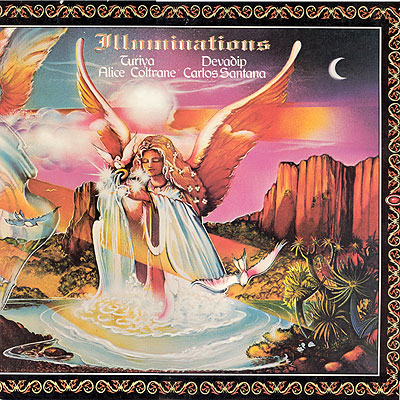
Carlos Santana & Alice Coltrane - Illuminations (1974)


AMG totally slams this record, gives it 2 stars. For me, it's really sublime and beautiful and I bet it would find some fans here. You would think with these two in the early 70s, this record would be really dense and noisy, but it's pretty minimal for the two of them. They are new versions of John Coltrane songs and they sure are pretty.

Of the five albums from Carlos Santana's jazzy period, four can be described as jazz/rock, altho the latter term is sometimes a stretch. Illuminations, Carlos' joint effort with Alice Coltrane, John's widow, cannot be so characterized at all except for one of the four instrumental tracks, "Angel of Sunlight." This jazz/rock fusion, also steeped in raga, is a showcase for the sort of fine guitar soloing expected from Carlos, as well as Santana-style percussion, good bass work, etc. The other three songs are jazz/classical. They are richly textured orchestral arrangements, heavy with sweeping strings arranged by Alice, who herself plays harp and mellotron. Jules Broussard plays flute as well as saxophone. (Where is that Santana percussion section?) Carlos' chief contribution is exquisite, sweet guitar notes, not ripping solos. The result is a majestic, celestial atmosphere, reflecting Carlos' and Alice's spiritual focus of the time. The song titles tell the story: "Angel of Air/Angel of Water," "Bliss: The Eternal Now," and the title cut. This music is not what you normally expect from Santana, but is very pleasant, very lovely, for sure.
-David C. Heires, Amazon.com

Buy Here
Download Here

A Certain Ratio - Early (2002)


I don't know ACR that well, but of the two albums I've heard, they didn't strike me as GREAT. As a collection of good singles or whatever this is much better to me. Basically Joy Division/Factory Records sound but much more NY-disco influenced. It's fun stuff. Plus it's on Soul Jazz Records, so you know it at least sounds good and IF YOU BUY IT it is bound to come with an awesome package.

With the Creation reissues of A Certain Ratio's catalog becoming increasingly tough to track down and with the post-punk revival going on around the time of its release, Early arrived right on time. Despite an uneven discography and an inexplicably numerous string of Joy Division comparisons, ACR was an excellent -- if inconsistent -- post-punk band that exemplified a spectacular movement against the old rock guard. In reality, it only seems right to refer to the ACR captured here as a post-punk band for chronology's sake. They came after the punk explosion of 1977, yet they had hardly anything in common with that movement. At their best, they used rock instrumentation to sound little like a rock band, laying a combination of disco, funk, and Latin percussion as the foundation of their sound. They hardly took a cue from punk, evidenced as early on as their second single, a cover of Banbarra's "Shack Up." Early, an assemblage of key moments and rarities that ends with 1985, is one of those compilations that makes no overt commitment to the fanatic or the curious -- an issue that's probably exacerbated by the inclusion of five Peel Session selections. As a result, four songs are presented in two versions, eating up space that could have been taken up by other highlights. The only case where this overlap can be excused is "All Night Party," their first single; the studio version is a drumless din of Mancunian miserableness, while the Peel Session version is given the death disco treatment with drums from Donald Johnson, who wasn't on board at the time of the song's original recording. It would be a bit of a cop-out on the part of the Soul Jazz label to view the second disc -- the one with the B-sides, rarities, and Peel Session material -- merely as the icing on the cake, the bonus. Though Early goes for the price of a single disc, the space provided could have been used a bit better. The discs are far from maxed-out content-wise, and there are a handful of damnable exclusions. However, this bizarre restraint might have more to do with the future of the ACR catalog than a few boneheaded decisions. All things considered, there is no shortage of great material here, and the packaging is phenomenal. A short film documenting the band's first trip to New York City is also included

-Andy Kellman, AMG

Buy Here
Soul Jazz
Download Here

Wednesday, September 24, 2008

The Specials - The Specials (1979)


Yesterday was really sunny in the morning. The sun basically comes through my bedroom window really bright when this is the case. It was great, so I decided to pull out one I hadn't listened to in awhile.

This is obviously sort of a classic, but I didn't really hear it until about 2-3 years ago, so maybe there are other people who haven't. Obviously most ska revival shit is awful but i can't help but love to play this album when i wake up and the sun is shining in my window. it's just a lot of fun and so excellently done, that it really does deserve "classic" status to me.

A perfect moment in time captured on vinyl forever, such is the Specials' eponymous debut album; it arrived in shops in the middle of October 1979 and soared into the U.K. Top Five. It was an utter revelation -- except for anyone who had seen the band on-stage, for the album was at its core a studio recording of their live set, and at times even masquerades as a gig. There were some notable omissions: "Gangsters," for one, but that had already spun on 45, as well as the quartet of covers that would appear on their live Too Much Too Young EP in the new year. But the rest are all here, 14 songs' strong, mostly originals with a few covers of classics thrown in for good measure. That includes their fabulous take on Dandy Livingstone's "A Message to You Rudy," an equally stellar version of the Maytals' "Monkey Man," and the sizzling take on Prince Buster's "Too Hot." If those were fabulous, their own compositions were magnificent. The Specials managed to distill all the anger, disenchantment, and bitterness of the day straight into their music. The vicious "Nite Klub" -- with its unforgettable line, "All the girls are slags and the beer tastes just like piss" -- perfectly skewered every bad night the members had ever spent out on the town; "Blank Expression" extended the misery into unwelcoming pubs, while "Concrete Jungle" moved the action onto the streets, capturing the fear and violence that stalked the inner cities. And then it gets personal. "It's Up to You" throws down the gauntlets to those who disliked the group, its music, and its stance, while simultaneously acting as a rallying cry for supporters. "Too Much Too Young" shows the Specials' disdain for teen pregnancy and marriage; "Stupid Marriage" drags two such offenders before a Judge Dread-esque magistrate, with Terry Hall playing the outraged and sniping prosecutor; while "Little Bitch" is downright nasty. Those were polemics; "It Doesn't Make It Alright" reaches a hand out to listeners and, with conviction, delivers up a heartfelt plea against racism, but even this number contains a sharp sting in its tail. It's a bitter brew, aggressively delivered, with even the slower numbers sharply edged, and therefore the band wisely scattered sparkling covers across the album to help lift its mood. The set appropriately ends with the rocksteady-esque yearning of "You're Wondering Now," the song that invariably closed their live shows. Even though producer Elvis Costello gave the record a bright sound, it doesn't lighten the dark currents that run through the group's songs; if anything, his production heightens them. It's left to guests Rico Rodriguez and Dick Cuthell to provide a little Caribbean sun to the Specials' sound, their brass sweetening the flashes of anger and disaffection that sweep across the record. And so, this was Britain in late 1979, an unhappy island about to explode. This enhanced CD reissue includes the videos for "Gangsters" and "Too Much," true must-see TV.

-AMG

Download Here