Showing posts with label experimental. Show all posts

Sunday, March 28, 2010

A To Z: Lemon of Pink - The Books


2003 was a bit of a revelatory year in music for me. It was the year in which I discovered indie music blogs, review sites, and discussion forums. I tracked Pitchfork reviews tirelessly, even going through their archives at the time. I followed Fluxblog updates everyday, downloading whatever new song that was uploaded. Like many teenagers of the time, I grew into adulthood at a time when information availability was expanding and knowledge of new and relevant music seemed entirely too vast to ever attempt to conquer.

Sometime during that year, I read a review about "The Lemon Of Pink" by The Books. Earlier, I had already lost much time during an obsession over the divisive "Ether Teeth" by Fog, a record that I found mentioned through Anticon message boards. A description of The Books sound seemed that it would fall in line with the abstract samples and acoustic instrumentation found on "Ether Teeth"...but you know, this record was actually critically acclaimed and deemed "good" by just about everyone. Therefore it should have been my favorite record ever.

"The Lemon of Pink" isn't my favorite ever, but it is very good. As the spring months have been approaching and the spring weather seems here to stay, I can think of few experimental records from this decade that fit the time so perfectly. The acoustic strings present throughout, the ethereal original vocals that float above the shimmering tones, the random vocal samples that seem to appear out of nowhere, sneaking up on your like a person yelling from across the street. This is a folk album that breaks all folk tradition.

There are few albums that that float by as quickly as "The Lemon Of Pink." From the first female voice stating the title of the record out through "That Right Ain't Shit" and even "PS", this album comes together best as a whole piece. It is rare indeed that one would put a song from this record on a mixtape, other than with the intention of breaking apart whatever the general theme of your mix was. As individual songs, this music is pretty - but doesn't make a whole lot of sense. As a 37-minute album, everything comes together, bleeding into one another, creating memories of past picnics, spring sports, setting suns over the beach.

Perhaps I romanticize this record too much. I don't adore or obsess over this record and rarely listen to it 7 years after it's initial release. However, when I do take the time to listen to it, to remember why I enjoyed it so much all those years ago and the positive impact it had on broadening my listening tastes in the years that came after, I am overjoyed with what The Books have accomplished with this album. It's not a perfect recording and in 2010 there are records that are similar that might do part of this sound better, but it is one of those records that can be conditionally perfect. Sometimes you just have to wait to find that condition.

Download Here

Tuesday, February 9, 2010

Bedroom Community

I would like to see this tour. But hey, I live in California.


Bedroom Community releases have gotten some backlash around the internet. I don't care, these are the best musicians on the planet as far as I'm concerned.

Monday, January 18, 2010

A To Z: Chessa - Shuttle358


We tend to give ambient music two distinct purposes:

1. To serve as inoffensive background noise for activities like studying, sleeping or perhaps barely waking up.
2. To serve as a special soundtrack to a unique situation we may find ourselves in: weaving through travelers at an airport, riding on a morning train, watching the snow fall outside.

I know of few people who choose to listen to ambient or drone music as a means of sparking lively conversation or who elect to share their new favorite microtonal artists with their peers. It is not an entertaining music, nor is it a significantly artistic music. Yet somehow these sound sculptures can manage to be the most quiescent or the most absorptive music we listen to.

We have heard over the last 30 years of the brilliance found within the minimal compositions of masters like Brian Eno and Harold Budd. In half the time, we have been able to add artists like Wolfgang Voight, William Basinski, Christian Fennesz and Stars of The Lid to that list. What was once a genre that few tread within, dominated by tape loops, hazy guitar pedals and the tinkling of keys on a synth or piano, soon blossomed during the laptop age of the early 2000's. Anyone could be a sound musician. I tried, you tried, we failed.

And though the genre of microtonal ambient music is far from dead - it is altogether saturated by carbon copy artists, all clawing (softly) for that one standout review handed out by a major publication every year.

I love ambient music, and while I'm in no way someone who follows the actual scene (and there is a true art-based minimal scene in every corner of the western world), nor am I even learned enough to be able to write for mapsadaisical, I delve into many new releases every year that happen to catch my attention during the hyperbolic ramblings of their press releases or Boomkat reviews. Every year many of them are nothing but boring, soulless electro-acoustic meanderings that start nowhere and go nowhere. "A guy, a laptop and a guitar walk into a bedroom..."

It is funny that we can consider a music with no specific form to adhere to but whatever one hears in their own head as "soulless", yet many releases within this genre are exactly that. Dan Abrams aka Shuttle358 is anything but soulless.

All positive reviews of ambient music make reference that a particular release is good because of the "warmth" and "humanity" that the music brings up for the listener. Specific memories in time are recaptured, current moments in the present are captured for the first time. Chessa is warm, Chessa is human.

Recorded and released during the apex of the click-and-beep madhouse of 2004, Shuttle358's third album on 12k has spoken to me for 5 years now. The fuzz, the chimes, the buzzing sounds, the looped guitar - these are all elements that can be found on releases by any ambient composer - and yet, this release sticks out from the others. I listened to this album four times this afternoon as I watched the rain come and go out my window. As night set in, earlier than it should have, the music continued to soundtrack my evening. Every track seems to find itself matching my breaths as it clicks along, every track placed perfectly in context with the exact emotion I encounter upon this experience.

It is a quiet album, a beautiful album - one that has many situational uses. It just turns out that its beauty has not allowed me to tie it to one situation in particular, but many. And few albums can do that.

Tuesday, April 21, 2009

Steve Reich - Different Trains / Electric Counterpoint (1989)


Two Steve Reich compositions on this disc. The first three tracks belong to "Different Trains" and are performed by the Kronos Quartet, whereas the latter 3 constitute "Electric Counterpoint" and is primarily performed by jazz guitarist Pat Metheny.

Different Trains
(1988) For string quartet and tape begins a new way of composing that has its roots in my early taped speech pieces It's Gonna Rain (1965) and Come Out (1966). The basic idea is that speech recordings generate the musical material for musical instruments.

The concept for the piece comes from my childhood. When I was one year old, my parents separated. My mother moved to Los Angeles and my father stayed in New York. Since they arranged divine custody, I traveled back and forth by train frequently between New York and Los Angeles from 1939 to 1945 accompanied by my governess. While these trips were exciting and romantic at the time, I now look back and think that, if I had been in Europe durin this period, as a Jew I would have had to ride very different trains. With this in mind I wanted to make a piece that would accurately reflect the whole situation. In order to prepare the tape, I had to do the following:
1 - Record my governess Virginia, now in her seventies, reminiscing about our train trips together.
2 - Record a retired Pullman porter, Lawrence Davis, now in his eighties, who used to ride lines between New York and Los Angeles, reminiscing about his life.
3 - Collect recordings of Holocaust survivors Rachella, Paul and Rachel - all about my age and now living in America - speaking of their experiences.
4 - Collected recorded American and European train sounds of the 1930s and 40s.

In order to combine the taped speech with the string instruments I selected small speech samples that are more or less clearly pitched and then notated them as accurately as possible in musical notation.

The strings then literally imitate that speech melody. The speech samples as well as the train sounds were transferred to tape with the use of sampling keyboards and a computer. Kronos then made four separate string quartet recordings which were combined with the speech and train sounds to create the finished work.

Different Trains is in three movements, though that term is stretched here since tempos change frequently in each movement. They are: America-Before the war, Europe-During the war, After the war.

The piece thus presents both a documentary and a musical reality, and begins a new musical direction. It is a direction that I expect will lead to a new kind of documentary music video theater in the not too distant future.
-Steve Reich, August 1988.

Electric Counterpoint
The soloist pre-records as many as ten guitars and two electric bass parts and then plays the 11th guitar part live against the tape. I would like to thank Pat Metheny for showing me how to improve the piece by making it more idiomatic for the guitar.

Electric Counterpoint is in three movements - fast, slow, fast - played one after the other without pause. The first movement, after and introductory pulsing section where the harmonies of the movement are stated uses a theme derived fro Central African horn music that I became aware of through ethnomusicologist Simha Arom. That theme builds to an eight-voice canon; while the remaining two guitars and bass play pulsing harmonies, the soloist plays melodic patterns that result from the contrapuntal interlocking of those eight pre-recorded guitars.

The second movement cuts the tempo in half, changes key and introduces a new thee which is then slowly built up to nine guitars in canon. Once again, two other guitars and bass supply harmony while the soloist brings out melodic patterns that result from the overall contrapuntal web.

The third movement returns to the original tempo and key and introduces a new pattern in triple meter. After the establishment of a four-guitar canon, two bass guitars enter suddenly to further stress the triple meter. The soloist then introduces a new series of strummed chords that are then built up in three-guitar canon. When these are complete, the soloist returns to melodic patterns that result from the overall counterpoint. Suddenly the bases begin to change both key and meter back and forth between E minor and C minor and between 3/2 and 12/8 so that one hears the first three groups of four eighth-notes and then four groups of three eighth-notes. These rhythmic and tonal changes occur more and more rapidly until, at the end, the basses slowly fade out and the ambiguities are finally resolved in 12/8 and E minor.
-Steve Reich, September 1987

Download Here

Saturday, January 24, 2009

Svarte Greiner - Kappe (2009)


In the wake of the new administration and the general feeling of relief that is being experienced by most reasonable people, it has been hard to listen to music I would categorize as "dark." However, the brand new album by Svarte Greiner sort of throws all those rules out the window and has provided me with one of the most intense and awesome listening experiences I've heard in this new, infant year. While the Animal Collective album is clearly album of the year thus far (if not decade), Greiner's album fills the gap for essential paranoid nighttime listening (which is an actual essential). While Svarte's last solo album "Knive" came out on the wings of the amazing "Dead Sea" by labelmate/head Xela, "Kappe" is something that won't keep Svarte in the shadows much longer. While "Knive" was truly unsettling and sounded like the soundtrack to the scariest movie you've never seen (it all it's minimal glory), "Kappe" provides the listener with something that is dark and frightening, but more along the lines of the sound Greiner explores in his other group Deaf Center.

The album opens with "Tunnels of Love" which is 7 minutes of howling winds carrying screeching voices across miles of hills. In the foreground we hear the constant rattling of chains and windmills, dominating the silence that surrounds them. Soon thereafter a eerie synth loop repeats over and over until the track dissolves into the sound of actually being caught in a tunnel. A statement from the beginning.

"Where Am I" sounds like something that could be used to back some of the more unsettling scenes in 2001: A Space Odyssey. The sound of paranoia is clear. With subtle noise fading in and out, this track will have you looking over your shoulder if listened to in the dark. One of those tracks that definitely captures the mood of the title.

"Candle Light Dinner Actress" is more of the same with some strong tweaks. It's not hard to imagine yourself seated in an old haunted building watching ghosts roam about you while you anxiously try to eat dinner. Ridiculous I know, but once you listen, it's hard to shake.

The album closes with "Last Light" which is an interesting track in that it is undoubtedly the loudest of the bunch, with a constant echo and synth line apparent throughout, with other sounds weaving in and out of the mix. However on it's own, parts of the song could sound like it is soundtracking something fresh, providing us with a glimpse of hope and light and life, yet such is obviously not the case. The song wraps up the album as a bright spot, telling the listener "this is it, you're going to fall prey to silence after, so take all of this in."

A great album and likely my second favorite I've heard so far this year.

Myspace
Website
Type Records

Download


Tuesday, November 18, 2008

Secret Chiefs 3 - Xaphan: Book of Angels Vol. 9 (2008)


Here's another one. Pretty experimental, but ultimately very rewarding. Some parts are definitely harsh, but not quite as crazy as a typical Mr. Bungle/SC3 album. Very enjoyable overall.

Spruance, best known as the guitarist for the seminal avant-rock band Mr. Bungle, has in recent years been principally absorbed with the Secret Chiefs 3, a project that, like much of Zorn's best work, defies categorization. Spruance has performed for Zorn now and again, although I have to confess that after hearing his criticism of Weird Little Boy (a little digging online will uncover details), I did not expect another collaboration.

But we did get "Xaphan", and am I grateful. Spruance takes eleven of Zorn's Masada compositions and brings them across the world and back again, stray traces of funk, surf, world (particularly Arabic), techno and a thousand other sounds blend seamlessly together to form a cinematic soundscape. The album opens with a deep groove established by bassist Shahzad Ismaily and drummer Ches Smith on opener "Sheburiel" and pretty much never lets go. It manages to be cinematic and mournful ("Barakiel"), full of stunning performances (Rich Doucette's sarangi solo on "Bezriel", Spruance's guitar leads on "Labbiel") and the expected great melodies from Zorn ("Asron" is of particular note). In many ways, the album accomplishes what I felt Koby Israelite's Orobas: Book of Angels, Vol. 4 was trying to do.

I think in the end, this is one that anyone who might be interested in it will be really happy with-- "Xaphan" is a fine example of just how extraordinary both Zorn is as a composer but also of the arranging skills of Spruance. Highly recommended.
-Michael Stack, Amazon.com


Download Here

Sunday, November 16, 2008

Marc Ribot - Asmodeus: Book of Angels Vol. 7 (2007)


Don't judge this album based on the first track alone. It's that crazy fucking skronk rock jazz noise shit that Ribot is known for and the groups on Rune Grammofon are making hip. It's loud and abrasive as all get out and difficult for me to listen to, but this whole record doesn't sound like that.

Which isn't to say that it doesn't have Ribot's signature all over it. It's still full of blistering guitar, jazz that goes everywhere rather than nowhere, touches all spectrums, but never really drags. Ribot further shows Zorn's diversity with his entry into the Masada Book, because this album sounds like none of the other 6 volumes before it, nor much else any music around it. Dude makes it his own, and it slays. It's crazy, it's not my favorite, but it is definitely an adventurous listen.


"Asmodeus" is the seventh installment in John Zorn's Masada Book II. In case anyone reading is unfamiliar, a brief introduction: in the early '90s, Zorn began exploring his Jewish and Jazz heritages through the composition of a songbook of themes that could serve as a sprinboard for improvisation. He composed some 200 songs for the original jazz quartet, eventually expanding the project to be performed by other acts. Over a decade after its inception, Zorn revitalized the aging (by his standards) project by injecting a new songbook into the mix-- the Book of Angels, a collection of around 300 new themes. Instead of focusing on a band this time, Zorn has had different groups perform the material. "Asmodeus" presents ten pieces from the book as performed by a rock power trio led by guitarist Marc Ribot, ably supported by bassist Trevor Dunn and drummer G. Calvin Weston.

What follows is something that, even moreso than Electric Masada did, will shake your impression as to where this project can go. From the opener "Kalmiya"-- it's clear that this is something forceful-- Ribot comes blazing out with a frantic, noisy, overdriven guitar solo over a raging rhythm section before settling into a bit of a monster groove, with the melody eventually floating above (or perhaps in opposition to) a freely associating Dunn and Weston. Quite frankly, it's like Ornette Coleman's Prime Time project on steroids.

While the record admittedly settles down a bit (the second track, "Yezriel", finds the trio slinking into a blues rock feel after the explosive opener), the performance maintains a raging intensity and seemingly endless blistering guitar pyrotechnics throughout. Admittedly, at times this causes the performance to deviate a bit, capturing this sort of performance almost universally works better in a live setting where you can really see and feel the interaction and energy between the band, and here it can cause the pieces to occasionally feel disjoint ("Kezef" where Ribot seems tentative, "Armaros" where Dunn does, at least after his solo). Sometimes I suspect this was the intent-- if the goal was to capture a live energy here, it would stand to reason that you'd avoid repeated takes and sometimes you'll end up a bit disjoint. On the other hand, sometimes you'll end up so disjoint that what you'll have its a piece that bubbles over with so much energy, you can't help but be in awe of it, and Ribot's sound, while consistent on the record, still somehow manages to be all over the map, touching on John McLaughlin ("Yezriel"), Sonny Sharrock ("Cabriel") and Blood Ulmer ("Sensenya"), not to mention literally dozens of others.

One thing I can safely say about "Asmodeus", by the time it wraps up, you can almost feel exhausted. It is an immensely powerful record, and again while perhaps not as consisently successful as other entries in the Masada Book II catalog (the Masada String Trio record comes immediately to mind), this one is so overwhelming in its dissection and deconstruction of the rock idiom that it's hard to think of it as anything short of fantastic. Recommended.
-Michael Stacks, Amazon.com


Download Here

Saturday, October 18, 2008

Koby Israelite - Orobas: Book Of Angels Vol. 4 (2006)


This album is fucking bizarre dudes. Another set of Zorn tunes, but this one is definitely one of the most far out from the Book of Angels series. The album is all over the place. One song will be Jewish/Turkish electronic fusion stuff like Balkan Beat Box, the next will be traditional, the next will sound like heavy metal, the next traditional, the next jazzy, the next fusion etc. It's a fucking blast and definitely NOT background music. Not for everyone, but if you are a fan of bands like Secret Chiefs 3 or whatever, this album is pretty good. Find joy in the schizophrenia.

Koby Israelite has issued two previous CDs for the Tzadik label, Dance of the Idiots and Mood Swings. Both showed a tremendous flair for composition, instrumental acumen, humor, and an ability to shift genres without batting an eye. Israelite was born in Tel Aviv, and has played everything from traditional Hebrew folk music, classical music (he was trained on piano at a conservatory from the age of nine), and he's a huge fan of heavy metal and has played in a number of metal and punk bands. This set of John Zorn tunes -- from Zorn's second Masada book -- Orobas: Book of Angels, Vol. 4 was handpicked by the composer. The results are stellar. There's the Yiddish gypsy blues that meld with funk and jazz on "Czgadi," where accordions engage in contrapuntal free form with a fretless bass before guitars and trap kits move to the center of the mix. The startling metal guitar riffing that introduces "Zafiel" is splayed out by Turkish folk melodies by mid-track. Then there are the mariachi-styled melody lines played by trumpets, electric guitars, Farfisa organs, and a drum kit on "Khabiel"; the mood changes, the genres smash and meld effortlessly (klezmer melodies and reggae enter and leave seamlessly and the track is taken out by a kind of prog-surf metal before it ends), and the music becomes hypnotic while remaining exciting, even breathtaking. The other musicians who lay here -- trumpeter Sid Gauld, Stewart Curtis on recorders, piccolos and clarinet, and Yaron Stavi on bass, (Israelite plays no less than eight instruments himself) -- are in top-flight, and this feels more like a band than an individually directed effort. And perhaps that too is a strength Israelite possesses, to place his imprint on Zorn's music in an idiosyncratic way, and still give his ensemble an individual identity. As for the series, Orobas: Book of Angels, Vol. 4 is another essential Four-for-four and counting. This is the most exhilarating set of recordings Tzadik has offered in quite some time. For those who haven't yet checkout Israelite, this is a fantastic opportunity.
-Thom Jurek, Allmusic.com


Download Here

Thursday, October 9, 2008

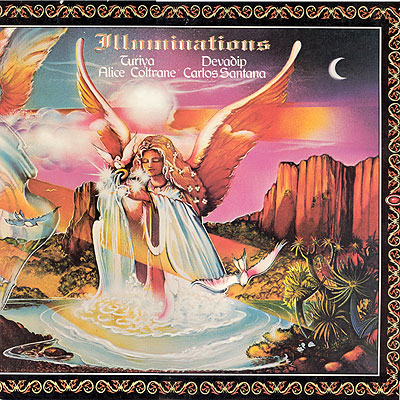
Carlos Santana & Alice Coltrane - Illuminations (1974)


AMG totally slams this record, gives it 2 stars. For me, it's really sublime and beautiful and I bet it would find some fans here. You would think with these two in the early 70s, this record would be really dense and noisy, but it's pretty minimal for the two of them. They are new versions of John Coltrane songs and they sure are pretty.

Of the five albums from Carlos Santana's jazzy period, four can be described as jazz/rock, altho the latter term is sometimes a stretch. Illuminations, Carlos' joint effort with Alice Coltrane, John's widow, cannot be so characterized at all except for one of the four instrumental tracks, "Angel of Sunlight." This jazz/rock fusion, also steeped in raga, is a showcase for the sort of fine guitar soloing expected from Carlos, as well as Santana-style percussion, good bass work, etc. The other three songs are jazz/classical. They are richly textured orchestral arrangements, heavy with sweeping strings arranged by Alice, who herself plays harp and mellotron. Jules Broussard plays flute as well as saxophone. (Where is that Santana percussion section?) Carlos' chief contribution is exquisite, sweet guitar notes, not ripping solos. The result is a majestic, celestial atmosphere, reflecting Carlos' and Alice's spiritual focus of the time. The song titles tell the story: "Angel of Air/Angel of Water," "Bliss: The Eternal Now," and the title cut. This music is not what you normally expect from Santana, but is very pleasant, very lovely, for sure.
-David C. Heires, Amazon.com

Buy Here
Download Here

Saturday, October 4, 2008

Esbjörn Svensson Trio - Leucocyte (2008)


I don't usually post new albums, but I thought I'd make an exception today and we'll see what happens.

So i spent a good part of today downloading and looking at some jazz releases from this year because I hadn't really been paying attention. I went to look up what EST had put out this year, only to be shocked that Esbjorn had died in June and here I am 4 months later and didn't even know. Awful. Truly awful to lose such a talent and someone who has been consistently putting out great records and really keeping modern jazz exciting. This trio is basically the biggest European name in progressive jazz in the last few years, and were the first European band on the cover of Downbeat magazine last year, I believe. Anyway, I've liked all the albums I've heard of theirs, but this one blew my mind. The first six tracks are sort of all over the place, but still flow really well. The "Premonition" tracks are great, and the ones that follow are more based in jazz. The album closes with a suite named after the album, and it is experimental and really cutting edge and exciting. A really engrossing record that is out there, but not necessarily by being really loud and abrasive (though it is not subtle either). Definitely one of the best "first listen's" of a new album this year. Highly recommended.

Considering that this is the last we will ever hear from the wonderful e.s.t (pianist Esbjorn Svensson having tragically died in a diving accident earlier this year, at the age of 44) it's impossible not to feel sadness while listening to Leucocyte. Yet it's not for just the passing of one of the world's most talented jazz musicians. It's also for the fact that a band, so psychically linked and at ease with each other should, at this fascinating stage of their development, be robbed of the chance to grow and change as they undoubtedly would have done.

Composed of childood friends Svensson and drummer Magnus Ostrom, along with bassist Dan Berglund, e.s.t's last album, Live In Hamburg, seemed to be drawing a line under the ECM-friendly-with a-touch-of-rock-trio period of their career. Equally at home on the festival as well as jazz circuits, you could feel it was time for a change.

Leucocyte reminds you that, despite carrying the pianist's name, the trio were a band of equal thirds. It's Berglund's earthy tones that drive much of the first half of the album. Following the delicate introductory meditation, Decade, Premonition sounds hungry for just such a change. The feedback and distortion are comparable to Australia's Necks, but under it all Svensson's voice echoes the changes, and his keys can never resist the Jarrett-esque flourishes that trip lightly over the atmospherics. Not once does the soloing take the place of progression and thematic exploration. And the attack always veers towards that rock aesthetic that rears its head most ironically on the number entitled Jazz.

But it's the album's second half suite, Leucocyte, that indicates where the trio were headed next. Mixing in far more electronics; erasing melody, leaving just the warp and weft of instrumental texture, and even (on part two's Ad Interim) resorting to total silence: it shows us a band that were now fearless and confident enough to really experiment.

Leucocyte is far from a perfect album, and that's why it's so heartbreakingly good. It's unsure in parts, and occasionally too wilfully rough. But it's a pointer to a future that's been cruelly denied us. We can only dream of what might have happened next. But thank goodness we have this to remember Svensson by. It's a testament to an artist whose life was always a work in progress.

-Chris Jones, BBC

Download Here
Buy Here

Sunday, September 14, 2008

A To Z: V - Vernal Equinox by Jon Hassell


For you meditative dudes out there, here is one of my favorite "out there" albums.

For those who don't know Jon Hassell, he was an avant-garde trumpet player who has played with a lot of people on the forefront of experimental music through the years as well as world music. His whole goal was to basically blend styles until there was no style, he called it "Fourth World"

It's just beautiful, minimal stuff. Here is a piece that Brian Eno wrote about him. Enjoy the download.

I arrived in New York on a beautiful spring day in April 1978. I'd intended to stay for a week but the visit stretched on and on and I ended up staying for about five years.

Those first few months in the city were a formative time for me. I didn't know many people, and I had time on my hands, so I was open to things in a way that I might not have been in a more familiar landscape. I listened to a lot of live music and bought a heap of records. One of the most important was by a musician I'd never heard of - a trumpeter called Jon Hassell. It was called Vernal Equinox.

This record fascinated me. It was a dreamy, strange, meditative music that was inflected by Indian, African and South American music, but also seemed located in the lineage of tonal minimalism. It was a music I felt I'd been waiting for.

I discovered later, after I met and became friends with Jon, that he referred to his invention as Fourth World Music (which became the subtitle of the first album we made together: Possible Musics). I learned subsequently that Jon had studied at Darmstadt with Stockhausen (as indeed had Holger Czukay from Can, another occasional colleague), that he'd played on the first recording of Terry Riley's seminal In C, and that he'd studied with the great Indian singer Pran Nath.

We had a lot to talk about. We had both come through experimental music traditions - the European one, as exemplified by Stockhausen and Cornelius Cardew, and the American one of Cage and Terry Riley and LaMonte Young. At the same time, we were aware of the beauty and sophistication of all the music being made outside our culture - what is now called "world music". And we were both intrigued by the possibilities of new musical technology.

But beyond these issues, there was a deeper idea: that music was a place where you conducted and displayed new social experiments. Jon's experiment was to imagine a "coffee coloured" world - a globalised world constantly integrating and hybridising, where differences were celebrated and dignified - and to try to realise it in music.

His unusual articulacy - and the unexpected scope of his references - inspired me. In general, artists don't talk much about how or why they make their work, especially "why". Jon does. He is a theorist and a practitioner, and his theories are as elegant and as attractive as his music: because in fact his music is the embodiment of those theories.

We spent a lot of time together, time that changed my mind in many ways. We talked about music as embodied philosophy, for every music implies a philosophical position even when its creators aren't conscious of it. And we talked about sex and sensuality, about trying to make a music that embraced the whole being and not just the bit above the neck (or just the bit below it).

It was in these conversations that, among other things, My Life in the Bush of Ghosts, which I made with David Byrne in 1981, was nurtured. All of us were interested in collage, in making musical particle colliders where we could crash different cultural forms with all their emotional baggage and see what came out of the collisions, what new worlds they suggested.

If I had to name one over-riding principle in Jon's work it would be that of respect. He looks at the world in all its momentary and evanescent moods with respect, and this shows in his music. He sees dignity and beauty in all forms of the dance of life.

I owe a lot to Jon. Actually, a lot of people owe a lot to Jon. He has planted a strong and fertile seed whose fruits are still being gathered.

-Brian Eno

Download Here

Tuesday, September 2, 2008

A To Z: S - Shleep by Robert Wyatt


I should probably first admit that I don't really know enough about Prog and the Canterbury scene to fully try to digest an artist like Robert Wyatt. No, in fact, it wasn't until last year that I actually delved into a few of Wyatt's solo releases (with the joy that Comicopera was), and I've loved most of the Soft Machine's albums for years.

Shleep is an excellent release in a pretty spotty discography, sounding very akin to a 70s ers Brian Eno record. The title of the record is apt, as it provides a great, hazy, beautiful, dream-like quality and atmosphere that is constructed around what are pretty decent pop songs. This record was not recorded in the 70s (though Eno did help), but it was recorded in 1997.

Anyway, it's a nice listen. Experimental and out there, but not nearly as bracing as much of his other work. It serves as a good introduction to an otherwise hard musician to digest.

Robert Wyatt was the drummer and founding member of the Canterbury, England based Soft Machine, who played arty, psychedelic, Pink Floyd-influenced jazz-rock fusion. Although his output has been spotty and sporadic, he has been revered for escaping the syrupy art-rock pretentiousness that his colleagues drowned in. Like Captain Beefheart, Wyatt has maintained a playfully unselfconscious experimentalism that may make for difficult listening, but is never boring. Shleep is a welcome comeback which, on first listen, reminded me of an old Brian Eno album. Sure enough, the booklet revealed that Eno did indeed arrange the first song, "Heaps of Sheeps." He also plays on two other songs. Wyatt's high, fragile voice is also similar to Eno's. Like this album, Wyatt's mid-70s solo albums, Rock Bottom (1974) and Ruth Is Stranger Than Richard (1975), mined the same cracks found between pop, art-rock and the avant-garde as Eno's post-Roxy Music solo albums of the same era. The main difference on Shleep is that the music is a gentler, prettier version of the old Wyatt, who could at times be abrasive in both sound and his ruthless politics. His lyrics are not all flight and whimsy, however. "Free Will and Testament" and "Blues in Bob minor" show that his politics have only grown more subtle in his old age, making more timelessly powerful songs in the long run.

-A.S. Van Dorsten
-Fast n Bulbous.com

Download Here

Sunday, August 31, 2008

A To Z: R - Raindance by Gryphon


AMG has this album rated at 1.5 stars. Really. Check it out here.

Yes it's not the best album that Gryphon put out, but it's not bad. It's a delightful little prog rock album, steeped in the keyboard flourishes and a krauty, droning sound. It catches a lot of flack because it is definitely different than Gryphon's albums before this, which were sort of like really nerdy medieval folk prog pieces, which are a lot of fun in their own right. However, the variety on Raindance is why I like it.

Track 2, "Raindance" is basically just a 5-minute interpretation of falling rain, simulated by a keyboard, and that is followed by the great Lennon/McCartney song "Mother Nature's Son"...here done in a bit of a more 70s, folk rock manner. Immediately following that is "Le Cambrioleur Est Dans Le Mouchoir" which sounds like the soundtrack to some funny movie from the 30s. And the next song sounds like it should open up a PBS special or something.

Listen, it's not the best album, but it's an enjoyable listen with lots of variety in the sound. At the very least, you should download this album for the closing track "(Ein Klein) Heldenleben" which is 15+ minutes of Prog gloriousness.

It's not a challenging listen, but it's fun for sure.

RYM Reviews
Prog Archives Review

Download Here

Monday, May 5, 2008

A To Z: N - Night Through: Singles And Collected Works 1976-2004 by Loren Connors


Well, I've spoiled you with this one. Night Through is an amazing collection the guitar demi-god spread over 3 discs. There is a ton of different stuff spread over these 70+ tracks, from his americana-style pickings to the weird-experimental avant-garde sound to the sublime ambient stuff he is most known for now. I would never call this collection essential, because it is a lot of music, and I can rarely digest even half of it. But I will tell you that all of it is excellent. A truly unheralded legend, introduce yourself to Loren Connors.

Not too many instrumentalists could put together a three-disc set of music released on 7” singles, but Loren Connors (aka Loren Mattei, Loren MazzaCane, Loren MazzaCane Connors – and we’re just talking the names that appeared on these singles) is not your average instrumentalist. Inspired by Mark Rothko, J.S. Bach, and most of all the blues, Connors has been pursuing his art constantly since the Carter administration; he would press his own LPs in batches of 50 and glue pictures on their sleeves before labels wised up and clamored to release his records in the late 1990s. That flow of records has slowed in recent years, with only one 7” released since 2000, but the previously unreleased material on the third disc of Night Through shows that Connors is still searching and changing.

Loren’s music works well in short doses; some of his singles only had music on one side, but I never felt short-changed when I bought one. The temporal confines seemed to focus his attention, bring him right to the point. But even on a little vinyl platter, he indulged a penchant for musical narrative; “Deirdre of the Sorrows” moves through four discreet movements in five minutes. Such works necessarily lose a bit of their stand-alone impact when you hear them as part of an hour-plus program, or when you go straight to them with a button rather than dig 'em out of the box, take 'em out of the sleeve, and put 'em on the turntable. But they gain something else. Thanks to mastering engineer Jim O’Rourke, many of these tracks sound much more present than they did crammed onto often crackly vinyl.

Night Through’s mostly chronological presentation charts Connors’ artistic maturation and subsequent efflorescence. He moans over careening acoustic slide licks on the set’s earliest recording, a previously unissued cover of “Come On In My Kitchen” from 1976. There was too much obvious effort in his music back then; when he pressed up the earliest release of this set, “Ribbon of Blues,” 10 years later Connors had already reined in and amplified his playing, and his voice was well in the background, soon to disappear completely. By the time of his next EP, “Mother & Son” (1992), Loren had distilled his music into a force of evocation rather than display; the notes are sparse and short and always bent, implying the tenderness and ache of bonds between parent and child rather than shoving your face in it. Around this time Connors learned that he had Parkinson’s disease, which forced him to further pare back his playing, and also accounted for the sheer volume of music that poured our of him for the rest of the decade – he didn’t know how much time he had to make it. It also forced him to pick his notes carefully, since he could no longer play so many of them. He has explored various themes; his Irish Catholic heritage, the streets of New York City, universal and specific experiences of loss, even his bad relationship with canines. He has also explored different techniques; his clean-toned early-'90s playing is worlds away from the echo-laden wah-wah cries on the previously unreleased “For Miles Davis,” which was recorded in 2004, but they’re still unmistakably the work of one man.

Disc one includes one suite from 1996, “Battle of Clontarf,” that never made it to disc and counts as one of the great finds of this collection. His wife Suzanne Langille delivers a blood-thickening, hate-filled text on one track; her dry, tremulous delivery closely matched her husband’s playing, and her words perfectly captured the rage of the disenfranchised Irish. On the next, Connors rings out a fuzz-toned melody that sounds like a hymn sung from a wind-blasted, battle-torn hill. And on yet another, you can hear the distant sounds of dishes being done – Connors recorded nearly everything here at home, and his prolific output is partly the consequence of a readiness to do the work regardless. Just like a painter paints or a writer writes every day even though they are denied immediate contact with their audience, this player plays no matter what.

The second disc is book-ended by temporally out-of-sequence pieces that offer glimpses of Connors’ roots. The opening duet with the more traditional singer Robert Crotty just shows how distant Loren was from the blues mainstream, even in 1981; his liberal use of dissonance and over-the-top vocalizing seems to tug Crotty from the back porch into some dark forest. It ends with “Peace,” a lamentation sung in 1959 by his mother in church while young Loren kicked at the pews. Her voice carries over the organ in a way that Loren’s own leads soar over his grinding accompaniment (like Bach, Connors likes counterpoint, and generally overdubs several guitar tracks to get it). In between are some of his best recordings: the dark, pummeling “Exile”; the dramatic, keening “The End, The Afternoon, The Light”; the sober restraint of “For NY 9/11/01,” which was originally released as a CD-R. His most recent single, the 2003 release “Moon Gone Down,” points to new directions; Connors uses field recordings of wolves and a menacing, reticent bass guitar instead of the old rhythm chords, which results in some of his sparsest and eeriest music.

The third disc is essentially a bonus album; aside from a few compilation tracks, it’s all previously unreleased stuff, some of it pretty recent. There’s a titanic live cut by Haunted House, his late-90s rock band with Langille and members of San Agustin, and “I Love You Porgy,” a rare and uncommonly sweet dip into the standard repertoire. There are some recent explorations of the ghostly sound world that Miles Davis unearthed when he recorded “He Loved Him Madly,” even a tribute to the Dark Prince himself. Handsomely packaged and well annotated, Night Through gives another enduring and constantly evolving artist his due.
-Bill Meyer (Dusted Magazine)