Showing posts with label ambient. Show all posts

Monday, January 18, 2010

A To Z: Chessa - Shuttle358


We tend to give ambient music two distinct purposes:

1. To serve as inoffensive background noise for activities like studying, sleeping or perhaps barely waking up.
2. To serve as a special soundtrack to a unique situation we may find ourselves in: weaving through travelers at an airport, riding on a morning train, watching the snow fall outside.

I know of few people who choose to listen to ambient or drone music as a means of sparking lively conversation or who elect to share their new favorite microtonal artists with their peers. It is not an entertaining music, nor is it a significantly artistic music. Yet somehow these sound sculptures can manage to be the most quiescent or the most absorptive music we listen to.

We have heard over the last 30 years of the brilliance found within the minimal compositions of masters like Brian Eno and Harold Budd. In half the time, we have been able to add artists like Wolfgang Voight, William Basinski, Christian Fennesz and Stars of The Lid to that list. What was once a genre that few tread within, dominated by tape loops, hazy guitar pedals and the tinkling of keys on a synth or piano, soon blossomed during the laptop age of the early 2000's. Anyone could be a sound musician. I tried, you tried, we failed.

And though the genre of microtonal ambient music is far from dead - it is altogether saturated by carbon copy artists, all clawing (softly) for that one standout review handed out by a major publication every year.

I love ambient music, and while I'm in no way someone who follows the actual scene (and there is a true art-based minimal scene in every corner of the western world), nor am I even learned enough to be able to write for mapsadaisical, I delve into many new releases every year that happen to catch my attention during the hyperbolic ramblings of their press releases or Boomkat reviews. Every year many of them are nothing but boring, soulless electro-acoustic meanderings that start nowhere and go nowhere. "A guy, a laptop and a guitar walk into a bedroom..."

It is funny that we can consider a music with no specific form to adhere to but whatever one hears in their own head as "soulless", yet many releases within this genre are exactly that. Dan Abrams aka Shuttle358 is anything but soulless.

All positive reviews of ambient music make reference that a particular release is good because of the "warmth" and "humanity" that the music brings up for the listener. Specific memories in time are recaptured, current moments in the present are captured for the first time. Chessa is warm, Chessa is human.

Recorded and released during the apex of the click-and-beep madhouse of 2004, Shuttle358's third album on 12k has spoken to me for 5 years now. The fuzz, the chimes, the buzzing sounds, the looped guitar - these are all elements that can be found on releases by any ambient composer - and yet, this release sticks out from the others. I listened to this album four times this afternoon as I watched the rain come and go out my window. As night set in, earlier than it should have, the music continued to soundtrack my evening. Every track seems to find itself matching my breaths as it clicks along, every track placed perfectly in context with the exact emotion I encounter upon this experience.

It is a quiet album, a beautiful album - one that has many situational uses. It just turns out that its beauty has not allowed me to tie it to one situation in particular, but many. And few albums can do that.

Thursday, October 9, 2008

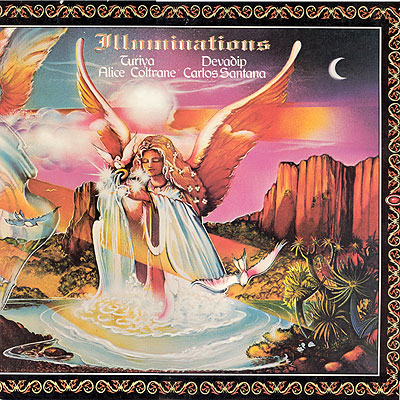
Carlos Santana & Alice Coltrane - Illuminations (1974)


AMG totally slams this record, gives it 2 stars. For me, it's really sublime and beautiful and I bet it would find some fans here. You would think with these two in the early 70s, this record would be really dense and noisy, but it's pretty minimal for the two of them. They are new versions of John Coltrane songs and they sure are pretty.

Of the five albums from Carlos Santana's jazzy period, four can be described as jazz/rock, altho the latter term is sometimes a stretch. Illuminations, Carlos' joint effort with Alice Coltrane, John's widow, cannot be so characterized at all except for one of the four instrumental tracks, "Angel of Sunlight." This jazz/rock fusion, also steeped in raga, is a showcase for the sort of fine guitar soloing expected from Carlos, as well as Santana-style percussion, good bass work, etc. The other three songs are jazz/classical. They are richly textured orchestral arrangements, heavy with sweeping strings arranged by Alice, who herself plays harp and mellotron. Jules Broussard plays flute as well as saxophone. (Where is that Santana percussion section?) Carlos' chief contribution is exquisite, sweet guitar notes, not ripping solos. The result is a majestic, celestial atmosphere, reflecting Carlos' and Alice's spiritual focus of the time. The song titles tell the story: "Angel of Air/Angel of Water," "Bliss: The Eternal Now," and the title cut. This music is not what you normally expect from Santana, but is very pleasant, very lovely, for sure.
-David C. Heires, Amazon.com

Buy Here
Download Here

Sunday, September 14, 2008

A To Z: V - Vernal Equinox by Jon Hassell


For you meditative dudes out there, here is one of my favorite "out there" albums.

For those who don't know Jon Hassell, he was an avant-garde trumpet player who has played with a lot of people on the forefront of experimental music through the years as well as world music. His whole goal was to basically blend styles until there was no style, he called it "Fourth World"

It's just beautiful, minimal stuff. Here is a piece that Brian Eno wrote about him. Enjoy the download.

I arrived in New York on a beautiful spring day in April 1978. I'd intended to stay for a week but the visit stretched on and on and I ended up staying for about five years.

Those first few months in the city were a formative time for me. I didn't know many people, and I had time on my hands, so I was open to things in a way that I might not have been in a more familiar landscape. I listened to a lot of live music and bought a heap of records. One of the most important was by a musician I'd never heard of - a trumpeter called Jon Hassell. It was called Vernal Equinox.

This record fascinated me. It was a dreamy, strange, meditative music that was inflected by Indian, African and South American music, but also seemed located in the lineage of tonal minimalism. It was a music I felt I'd been waiting for.

I discovered later, after I met and became friends with Jon, that he referred to his invention as Fourth World Music (which became the subtitle of the first album we made together: Possible Musics). I learned subsequently that Jon had studied at Darmstadt with Stockhausen (as indeed had Holger Czukay from Can, another occasional colleague), that he'd played on the first recording of Terry Riley's seminal In C, and that he'd studied with the great Indian singer Pran Nath.

We had a lot to talk about. We had both come through experimental music traditions - the European one, as exemplified by Stockhausen and Cornelius Cardew, and the American one of Cage and Terry Riley and LaMonte Young. At the same time, we were aware of the beauty and sophistication of all the music being made outside our culture - what is now called "world music". And we were both intrigued by the possibilities of new musical technology.

But beyond these issues, there was a deeper idea: that music was a place where you conducted and displayed new social experiments. Jon's experiment was to imagine a "coffee coloured" world - a globalised world constantly integrating and hybridising, where differences were celebrated and dignified - and to try to realise it in music.

His unusual articulacy - and the unexpected scope of his references - inspired me. In general, artists don't talk much about how or why they make their work, especially "why". Jon does. He is a theorist and a practitioner, and his theories are as elegant and as attractive as his music: because in fact his music is the embodiment of those theories.

We spent a lot of time together, time that changed my mind in many ways. We talked about music as embodied philosophy, for every music implies a philosophical position even when its creators aren't conscious of it. And we talked about sex and sensuality, about trying to make a music that embraced the whole being and not just the bit above the neck (or just the bit below it).

It was in these conversations that, among other things, My Life in the Bush of Ghosts, which I made with David Byrne in 1981, was nurtured. All of us were interested in collage, in making musical particle colliders where we could crash different cultural forms with all their emotional baggage and see what came out of the collisions, what new worlds they suggested.

If I had to name one over-riding principle in Jon's work it would be that of respect. He looks at the world in all its momentary and evanescent moods with respect, and this shows in his music. He sees dignity and beauty in all forms of the dance of life.

I owe a lot to Jon. Actually, a lot of people owe a lot to Jon. He has planted a strong and fertile seed whose fruits are still being gathered.

-Brian Eno

Download Here

Monday, May 5, 2008

A To Z: N - Night Through: Singles And Collected Works 1976-2004 by Loren Connors


Well, I've spoiled you with this one. Night Through is an amazing collection the guitar demi-god spread over 3 discs. There is a ton of different stuff spread over these 70+ tracks, from his americana-style pickings to the weird-experimental avant-garde sound to the sublime ambient stuff he is most known for now. I would never call this collection essential, because it is a lot of music, and I can rarely digest even half of it. But I will tell you that all of it is excellent. A truly unheralded legend, introduce yourself to Loren Connors.

Not too many instrumentalists could put together a three-disc set of music released on 7” singles, but Loren Connors (aka Loren Mattei, Loren MazzaCane, Loren MazzaCane Connors – and we’re just talking the names that appeared on these singles) is not your average instrumentalist. Inspired by Mark Rothko, J.S. Bach, and most of all the blues, Connors has been pursuing his art constantly since the Carter administration; he would press his own LPs in batches of 50 and glue pictures on their sleeves before labels wised up and clamored to release his records in the late 1990s. That flow of records has slowed in recent years, with only one 7” released since 2000, but the previously unreleased material on the third disc of Night Through shows that Connors is still searching and changing.

Loren’s music works well in short doses; some of his singles only had music on one side, but I never felt short-changed when I bought one. The temporal confines seemed to focus his attention, bring him right to the point. But even on a little vinyl platter, he indulged a penchant for musical narrative; “Deirdre of the Sorrows” moves through four discreet movements in five minutes. Such works necessarily lose a bit of their stand-alone impact when you hear them as part of an hour-plus program, or when you go straight to them with a button rather than dig 'em out of the box, take 'em out of the sleeve, and put 'em on the turntable. But they gain something else. Thanks to mastering engineer Jim O’Rourke, many of these tracks sound much more present than they did crammed onto often crackly vinyl.

Night Through’s mostly chronological presentation charts Connors’ artistic maturation and subsequent efflorescence. He moans over careening acoustic slide licks on the set’s earliest recording, a previously unissued cover of “Come On In My Kitchen” from 1976. There was too much obvious effort in his music back then; when he pressed up the earliest release of this set, “Ribbon of Blues,” 10 years later Connors had already reined in and amplified his playing, and his voice was well in the background, soon to disappear completely. By the time of his next EP, “Mother & Son” (1992), Loren had distilled his music into a force of evocation rather than display; the notes are sparse and short and always bent, implying the tenderness and ache of bonds between parent and child rather than shoving your face in it. Around this time Connors learned that he had Parkinson’s disease, which forced him to further pare back his playing, and also accounted for the sheer volume of music that poured our of him for the rest of the decade – he didn’t know how much time he had to make it. It also forced him to pick his notes carefully, since he could no longer play so many of them. He has explored various themes; his Irish Catholic heritage, the streets of New York City, universal and specific experiences of loss, even his bad relationship with canines. He has also explored different techniques; his clean-toned early-'90s playing is worlds away from the echo-laden wah-wah cries on the previously unreleased “For Miles Davis,” which was recorded in 2004, but they’re still unmistakably the work of one man.

Disc one includes one suite from 1996, “Battle of Clontarf,” that never made it to disc and counts as one of the great finds of this collection. His wife Suzanne Langille delivers a blood-thickening, hate-filled text on one track; her dry, tremulous delivery closely matched her husband’s playing, and her words perfectly captured the rage of the disenfranchised Irish. On the next, Connors rings out a fuzz-toned melody that sounds like a hymn sung from a wind-blasted, battle-torn hill. And on yet another, you can hear the distant sounds of dishes being done – Connors recorded nearly everything here at home, and his prolific output is partly the consequence of a readiness to do the work regardless. Just like a painter paints or a writer writes every day even though they are denied immediate contact with their audience, this player plays no matter what.

The second disc is book-ended by temporally out-of-sequence pieces that offer glimpses of Connors’ roots. The opening duet with the more traditional singer Robert Crotty just shows how distant Loren was from the blues mainstream, even in 1981; his liberal use of dissonance and over-the-top vocalizing seems to tug Crotty from the back porch into some dark forest. It ends with “Peace,” a lamentation sung in 1959 by his mother in church while young Loren kicked at the pews. Her voice carries over the organ in a way that Loren’s own leads soar over his grinding accompaniment (like Bach, Connors likes counterpoint, and generally overdubs several guitar tracks to get it). In between are some of his best recordings: the dark, pummeling “Exile”; the dramatic, keening “The End, The Afternoon, The Light”; the sober restraint of “For NY 9/11/01,” which was originally released as a CD-R. His most recent single, the 2003 release “Moon Gone Down,” points to new directions; Connors uses field recordings of wolves and a menacing, reticent bass guitar instead of the old rhythm chords, which results in some of his sparsest and eeriest music.

The third disc is essentially a bonus album; aside from a few compilation tracks, it’s all previously unreleased stuff, some of it pretty recent. There’s a titanic live cut by Haunted House, his late-90s rock band with Langille and members of San Agustin, and “I Love You Porgy,” a rare and uncommonly sweet dip into the standard repertoire. There are some recent explorations of the ghostly sound world that Miles Davis unearthed when he recorded “He Loved Him Madly,” even a tribute to the Dark Prince himself. Handsomely packaged and well annotated, Night Through gives another enduring and constantly evolving artist his due.
-Bill Meyer (Dusted Magazine)