Showing posts with label jazz. Show all posts

Saturday, March 20, 2010

A To Z: Journey In Satchidananda - Alice Coltrane


When you listen to a lot of different avant-garde jazz releases, you have to mentally prepare yourself. You don't listen to Cecil Taylor or Albert Ayler as background music. You don't put "Interstellar Space" on and just go ahead and do the dishes. Free jazz, spiritual jazz, vanguard jazz, this is is music literally created to combat the passive and often dismissive nature of people wanting to "listen" to jazz. With a notion of jazz being for the beatniks and the coffee shops, the idea was struck down quickly by these very masters - finding new ground in the same way that many psychedelic rock bands were allowing hippies to reach higher astral planes.

Alice Coltrane fits in with these masters perfectly. She created difficult music with her husband before his untimely death, and made a career of perpetuating different experiments that crossed various genre lines. However, with "Journey In Satchidanda", you don't have to mentally prepare yourself for the listening experience. It's not grating, it's beautiful. And regardless of where you are, it will pull you in. It works as both background music and as one of the most engaging listens in your library. It's a crossover record in the most personal way. And it gets better every time. Of all the spiritual jazz pioneers, perhaps none were quite as spiritual as Alice.

Oh and she plays the harp.

Alice also employs the piano in her repetoire, and on this album is joined by two of my favorite musicians: Pharoah Sanders on soprano sax and Charlie Haden on bass. These three create a dynamic nucleus that is engulfed by the constant drone provided by middle-eastern instruments the oud and tamboura. There have been many attempts at bridging traditional middle-eastern or indian instruments with western jazz music and I will say right here: "Journey In Satchidanda" is likely the best.

This is the rare album that expands the loose definition of jazz yet remains an accessible album. For those who like traditional jazz numbers or the lighter side, they are unlikely to feel too alienated with this release. For those who only like jazz that transports them places, that takes a while to understand - they will feel right at home here too.

The beauty this record can stop you in your tracks. It can cause obsession. It truly is a "journey".


Download Here

Sunday, February 21, 2010

A To Z: Ghetto Music - Eddie Gale


If seeing the cover photo of this album doesn't make you want to listen to it, obsess over it and consider it one of the coolest things in your collection - you just might not be human.

Eddie Gale standing hooded with shades, his trumpet in hand, with a canine ready to rip your skull off. His backing musicians for the record, similarly hooded, with different instruments, expressionless facades on their face. They have attained a higher power through music and their look is forcing you to follow suit. Powerful.

During the late 60's, every important jazz musician tried their hand at the spiritual jazz movement that Coltrane spawned and mastered. While this resulted in some of the most exciting and invigorating jazz music that exists today, it also caused a plethora of great musicians to release lackluster work just for the sake of being "experimental."

Prior to 1968, Eddie Gale was known as a backing musician of various forms of Sun Ra's Arkestra, as well as playing on Cecil Taylor's Blue Note debut. These are big names and by the time that Gale was set to release his debut under his own name - the recording was entirely funded by Blue Note co-founder Francis Wolff, who believed that what Gale was accomplishing with this record was something that could truly shape what jazz is perceived to be and where it can go.

And with good reason. Despite the fact that Eddie Gale's Ghetto Music remained one of the most obscure Blue Note releases for years and has since been remastered on an entirely different label, the album continues to stick out amongst a catalogue of some of the best music the world has ever seen.

The deeply moving album opens with "The Rain" beginning with acoustic guitar and Eddie's sister Joann singing in a style that doesn't seem far removed from Fairport Convention. At 40 seconds, the rest of the 17-member ensemble reveals themselves, a jazz beat pushed along by the two basses and two drummers, the 11 member chorus preaching the gospel. The song alternates between these pastoral folk passages and the louder ensemble moments, with Eddie's trumpet soloing in between. Soon Eddie and his sister find themselves in a duet, his trumpet much louder than her voice. The track builds and builds, repeating "Stop the rain...Stop the rain." When listening, it is hard to think of a more powerful opening track through any genre of music. The next 4 tracks continue the wave of blending gospel and jazz and a little funk, create mass amounts of cacophony that never quite sound like "noise." Gale retains the ability to reign his ensemble inward at the proper time, continuously create musical passages that layer themselves to the point of bursting, before stopping and allowing breath. The chorus keeps things interesting throughout the 40-minute duration, making themselves apparent and noticeable, but never the center of attention, which rightly belongs to the amazing instrumental work.

Eddie Gale's Ghetto Music is one of the best spiritual / protest jazz albums that exists. A snapshot of life in 1968 and one that can still ring true as a snapshot of life in 2010. Powerful music.


Download Here

Tuesday, June 23, 2009

Three Matthew Shipp Albums

Y'know why not? Uploaded these recently, all 3 are great. I have other recent uploads I could post, but here are these anyway.

Matthew Shipp is one of the best/most heralded jazz pianists of the last 10+ years. He somehow fuses avant-garde with hip-hop but maintains a strong hard jazz feel in his records. He recorded with J. Spaceman as well as Antipop Consortium. He's a good guy to follow.

Equilibrium (2003)

My favorite Shipp album I've heard. Killer album. One of the few jazz albums that would make it onto a "best of 00's" list for me.
"The key to this record's success is its fearless combination of approaches: jazz in a relatively pure form, as well as blended with a hip-hop/electronica sensibility. The mixes and effects, rather than diluting the essence, enrich it. So many pitfalls avoided, so many heights reached: Equilibrium is a brilliant record which should bear appeal to an incredibly wide range of listeners." -allaboutjazz
Download Here

One (2006)

Solo piano performance.
"Without the burden of having to prove his music’s merit to an imaginary crowd of tongue-wagging purists, Shipp achieves a more subtle, truer kind of fusion. One is a space in which Bill Evans’ impressionism and Cecil Taylor’s effluvious mindfucks can coexist and disintegrate together, as Shipp leaves jazz piano behind as seamlessly as he surveys its history, readily launching into cerebral passages that owe more to contemporary chamber music than jazz or blues traditions. Here’s hoping this release marks the beginning of a more tempered sense of ambition for Shipp." - tinymixtapes
Download Here

Harmonic Disorder (2009)

One of the best jazz albums I've heard this year. Brilliant playing.
The title Harmonic Disorder may read like this is one of Shipp's more intense outings, but the truth is, while it has wonderfully fiery moments, this is an intimate recording filled with new ideas, humor, depth, and warmth. -amg
Download Here

Thursday, May 7, 2009

Linc Chamberland - A Place Within (1977)


I'm on a roll right now, watch out.

So I definitely can't take credit for this album or anything about this musician because I just downloaded this from one of my favorite music blogs on the web: My Jazz World. That site is awesome. Super rare funky jazz and shit primarily from the 70s. Lot of different styles thrown into the mix, some are pretty bad, but guy running it, Smooth usually comes correct. This is definitely one of those occasions.

Obviously I downloaded it because of the album cover. Look at this Rasputin ass dude who looks like he should be playing british folk or something. This is actually just excellent late 70s jazz. Linc is the guitarist, but the album is full of badass sax, bass and drum solos as well. Got a scan from the blog of the record sleeve, so I'll type up the liners because that's what I do:

It's been some time since the jazz guitar was freed from the rhythm section and allowed to become the creative, improvising instrument its potential warranted. What Jimmy Blanton did for the bass, Charlie Christian did for the guitar and his efforts helped to create a whole nation of plectrum devotees. We are now faced with a generation that can embrace folk heroes, men as diverse as Jimi Hendrix, Larry Coryell and Jim Hall. The guitar has become a symbol of protest and liberation. Its six strings hold the key to fame and fortune, a chance to see the world on three chords a day. The least skilled practitioners are frequently the most successful. Today's garage rock band can be tomorrow's mascaraed superstars. The flash and the wah-wah pedal can overshadow a brilliant technique.

There have been plenty of spectacular near misses. George Benson's brief fling with Miles Davis was fascinating and hinted at greater things that never materialized. Wes Montgomery was asked to join John Coltrane but the connection was never made. One can only imagine the fireworks had Charlie Christian survived.

The release of this LP helps to insure that a great talent does not get overlooked. Linc Chamberland has been playing the guitar for over twenty years and this is his first record as a leader. If justice is to be had, his name will soon be listed among the greats of the instrument.

I first stumbled upon Linc at one of his Tuesday night Rapson's gigs in Stamford, Conneticut. I had long heard of him from admiring friends who couched there descriptions in adjectives fit for "the one that got away." Rapson's is a tiny club but it was packed like Reveren Ike's sermons the night I finally made it down. There was a devoted hush in the room that is all too rare in nightclubs. Linc entered, a black bearded intense looking fellow in his mid 30's, and soon proved the rumors correct. Notes and ideas flew so fast that it was hard to believe they were issuing from the man on the stool in the corner. I recall a version of Chick Corea's "500 Miles High" that continued for 30 minutes and threatened to levitate the room with its intensity. All this achieved without attachment, pedals, or gimmicks of any kind and only a small amplifier to project that incandescent sound.

Much time has passed since that night and now Muse Records is as excited as I am about Linc Chamberland. This record is his own story, told in his own term. The music is not unlike what transpires still at Rapson's. It is pure, honest, and refreshingly alive.

Linc, of course, did not emerge fully formed. He is a native of Norwalk, Conneticut and still lives there. The guitarist admits to first picking up the instrument because he "wanted to be a singing cowboy." He joined his first group, "The Rhythm Chords," when he was 15. This led to a lengthy stint with an R&B big band known as "The Orchids" that yielded one album and a chance for Linc to hone his writing and arranging skills. This band toured almost constantly, a fact that explains Linc's current reluctance to travel. At one point, this band was reduced to eating mustard sandwiches in Hawaii no less! Other groups followed with some fairly unique names: "Gasmask," "Gotham," and "Sawbuck." Linc began to put in a lot of studio time and worked with the jazzy version of Felix Caviliere's "Rascals" (Alice Coltrane, Joe Farrell, and Richard Davis were also along.) Lic started playing at Rapson's soon after and says the long running gig has "helped me find out a lot about myself."

Linc now makes his living from teaching. His reputation is deservedly strong: Charmberland alumni perform with Alphnse Mouzon, Judy Collins, Wishbone Ash and (believe it or not) Alice Cooper. He has over 40 students and finds the work "a constant creative challenge."

The musicians on this album are veteran associates of the guitarist. Lookout Farm leader Dave Liebman has been a regular Rapson's jammer. Australian Dr. Lyn Christie (a medical doctor in addition to his bass talents) only recently left the Chamberland fold and the young Bobby Leonard is Linc's current drummer.

An attempt to get Linc to talk about his music drew a dismissive wave. "It speaks for itself," he said, and indeed it does. I can only call attention to some highlights: Liebman's possessed soprano on Lyn Christie's "Place Within," Christie's tense, brooding arco bass on Chamberland's "1957" and Leonard's sensitive accompaniment on the trio feature "What's New." Chamberland's guitar holds it all together with rhythm playing that offers firm footing and solos that just don't stop. The music offers no compromise and holds back nothing.

Dave Liebman tracked down in Wethersfield, Conneticut, offered the following assessment of Linc: "He's a great musician and a fine human being." Further elaboration is unnecessary. Listen to the record.
-Jim Motavalli

Download Here


Monday, April 27, 2009

Don Ellis - Tears Of Joy (1971)


This is for the comments in the previous post. Great record anyway. Was thinking about posting Don Ellis' soundtracks to the French Connection movies sometime soon, so the post actually works. Outstanding album (double album!) from crazy ass Don Ellis. Haven't actually listened to this for awhile, so I'm gonna bow out to an AMG review:

Recorded in 1971, Tears of Joy is a Don Ellis classic. The sheer musical strength of this ensemble is pretty much unparalleled in his career. The trumpeter/leader had backed off -- a bit -- from some of his outlandish and beautifully excessive use of strange and unconventional time signatures, though there is no lack of pioneering experimentalism in tone, color, arrangement, or style. This double LP/CD features a string quartet, a brass octet (four trumpets, tuba, bass trombone, trombone, and French horn), four winds, and a rhythm section boasting two drummers, a percussionist, a bassist, and the Bulgarian jazz piano wizard Milcho Leviev. This is a sprawling album. Disc one is made up of short- to mid-length pieces, the most notable of which are the intense adrenaline surge of "5/4 Getaway" (with a killer string arrangement by Hank Levy, one of three arrangers on this set) and the blazing Eastern European klezmer meets Bulgarian wedding music meets hard bop blues of "Bulgarian Bulge." Leviev's solo on the latter comes right out of the knotty, full-on bore of the tune's melody (written by Ellis, who scored all but three selections), and cites everyone from Wynton Kelly to Scott Joplin to Mal Waldron. Elsewhere, such as on "Quiet Longing," the strings are utilized as the base and texture of color. One can hear Gil Evans' influence here, and in the restrained tenderness of this short work one can also hear Ellis' profound lyricism in his flügelhorn solo. The second disc's first moment, "How's This for Openers?," is a knotty composition that touches on bolero, Aaron Copland, and operatic overture. Levy's "Samba Bajada" is a swinging opus that uses tropes from early Deodato in his bossa years, Sergio Mendes, and Jobim, and weaves them through with an elegant, punchy sense of hard bop and the American theater. On the 17-plus minute "Strawberry Soup" (with a vocal quartet in the background), Ellis gets to show what his band is capable of in its different formations. Full of both subtle and garish colors, timbral grace and vulgarity, elegant and roughly hewn textures, and a controlled yet wildly divergent set of dynamics, this tune is one of the most adventurous and most brilliantly composed, arranged, and executed works to come out of the modern big band literature. It is virtually a big-band concerto. Ultimately, Tears of Joy stands as a singular achievement in a career full of them by a musical auteur whose creativity seemingly knew few if any bounds.
-Thom Jurek (as always, christ)

Download Here

Wednesday, November 19, 2008

Medeski, Martin & Wood - Zaebos: Book Of Angels Vol. 11 (2008)


The last album in the series thus far. This one done by perhaps the most well-known or famous of all the musicians that have appeared in the Masada Books. MMW are definitely known around the jam band scene, which is why I avoided them for so long. I still don't know much of their material, save for a couple of albums...but where I didn't much care for previous work I'd heard, this album and their other album that has been released so far this year "Radiolarians 1" are both outstanding and innovative. Definitely enjoyable, cool stuff.

I guess I will update the blog with the other Book of Angels releases when they end up getting released, but I hope you have enjoyed them so far (they each get about 40+ downloads it looks like).

Oh yeah, over at bolachas, those dudes stole one of my links for the Fred Frith album from this year. Now that has a whole ton of downloads. Funny.

The Book of Angels, Zorn's second book of Masada tunes, has been a continuing source of inspiration for the composer and his legion of interpreters. On Zaebos: The Book of Angels Vol. 11, Medeski, Martin & Wood's intimate understanding of Zorn's working method lends their interpretations of these sturdily crafted tunes an air of cleverly inspired authority.

Embracing a wealth of genres, instrumental combinations and stylistic detours, the veteran trio brings their signature sound to this melodically distinctive body of work; the end result is one of their most satisfyingly diverse efforts.

Dispensing with preconceived boundaries, the trio ranges far and wide across the spectrum of available sound. "Rifion" utilizes classic swinging piano trio dynamics, complete with brief detours into outside playing. "Malach ha-Sopher" unveils a moody, haunting tone poem, while "Jeduthun" adopts the stunning silences, harsh angularity and pneumatic rhythms of Zorn's own jump-cut/collage oriented approach towards popular music.

Plugged-in, the trio burns white-hot as they careen through the whiplash frenzy of "Zagzagel" and the propulsive anthem "Vianuel." Medeski's vintage analog keyboards squeal and sputter, Wood ferrets out subterranean reverberations from a fuzz-toned electric bass and Martin kicks out thorny polyrhythms as the trio basks in waves of distortion and electronic sustain.

Covering familiar ground, "Agmatia" and "Chafriel" ride groovy, modal melodies driven by swirling organ washes, hypnotic bass lines and snappy shuffle rhythms. Revealing their longstanding rapport, they invest the oblique angles of "Ahaij" with a string of inventive solos and edgy interplay.

Maximizing the gorgeous melodic potential of Zorn's writing, "Sefrial" and "Asaliah" recall the dreamy exotica of the composer's lounge-inspired ensemble, The Gift, as kaleidoscopic keyboard washes, languorous bass pulses and spare trap set ruminations expand with cinematic atmosphere.

Zaebos is a homecoming of sorts for both Zorn and the Brooklyn-based trio. An endlessly rewarding listen, this session is one of Medeski, Martin & Wood's most varied and enjoyable releases, and one of the most commanding interpretations of the Book of Angels.-
-Troy Collins, Allaboutjazz.com

Download Here

Tuesday, November 18, 2008

Bar Kokhba - Lucifer: Book of Angels Vol. 10 (2008)


If you are looking for any one release to start with when it comes to these Book of Angels albums, you might want to start with this one. If nothing else: this is one of my favorite albums from 2008. It's a full band this time around, pulling from a lot of the musicians that graced the first 9 albums (Ribot, Feldman, Cohen, Friendlander) and adds two percussionists in Cyro Baptista and Joey Baron. Amazing set of music. A great mix of some real jazz elements with the klezmer tinge. Watching their videos on Youtube, you can see this is a body of amazing musicians. Just beautiful stuff, great for just putting on and doing your business around the house.

The album hits the ground running-- opener "Sother" splits the theme between pizzicato strings and arco ones supporting guitar. But Masada is less about themes and more about being a springboard for improvisation like any great jazz composition and we get there fast-- Feldman takes an extended, powerful, and fierce solo, completely on fire and nudged along by Ribot. And really, these are the keys to what makes this record fantastic-- great playing and great support as a band whose level of interaction is a mix between near psychic response and Zorn's unique exertions over them (everything from switching accompaniment from arco to pizzicato to not at all to conducting triangle strikes and extending brilliant solos). The disc provides some great moments of sound and contrast, recalling old western themes ("Zazel"), high cinematic drama ("Mehalalel") and a playfulness not often found on Zorn records until recently (the sing-song "Azbugah", which evolves quickly into a brush feature for Baron, who creates a gentle, playful and understatedly brilliant performance). Along the way, we get a series of staggering performances on all instruments, although Feldman seems to steal the show pretty much consistently-- from his frantic performances on the opener and closer ("Abdiel") to his Nashville strains on "Rahal". The only real exception being Ribot's blues-drenched feature "Zechriel", where he digs deep and finds some of his more powerful blues exertions with Zorn swirling the band around him.

I originally started writing reviews on Amazon because I was frustrated with the glowing fanboy commentary that every album that was released seemed to get, but really, there's been nothing but great things to say about Zorn's most recent output, and "Lucifer" is no exception. Highly recommended.
-Michael Stack, Amazon.com

Go watch them on Youtube
Download Here

Secret Chiefs 3 - Xaphan: Book of Angels Vol. 9 (2008)


Here's another one. Pretty experimental, but ultimately very rewarding. Some parts are definitely harsh, but not quite as crazy as a typical Mr. Bungle/SC3 album. Very enjoyable overall.

Spruance, best known as the guitarist for the seminal avant-rock band Mr. Bungle, has in recent years been principally absorbed with the Secret Chiefs 3, a project that, like much of Zorn's best work, defies categorization. Spruance has performed for Zorn now and again, although I have to confess that after hearing his criticism of Weird Little Boy (a little digging online will uncover details), I did not expect another collaboration.

But we did get "Xaphan", and am I grateful. Spruance takes eleven of Zorn's Masada compositions and brings them across the world and back again, stray traces of funk, surf, world (particularly Arabic), techno and a thousand other sounds blend seamlessly together to form a cinematic soundscape. The album opens with a deep groove established by bassist Shahzad Ismaily and drummer Ches Smith on opener "Sheburiel" and pretty much never lets go. It manages to be cinematic and mournful ("Barakiel"), full of stunning performances (Rich Doucette's sarangi solo on "Bezriel", Spruance's guitar leads on "Labbiel") and the expected great melodies from Zorn ("Asron" is of particular note). In many ways, the album accomplishes what I felt Koby Israelite's Orobas: Book of Angels, Vol. 4 was trying to do.

I think in the end, this is one that anyone who might be interested in it will be really happy with-- "Xaphan" is a fine example of just how extraordinary both Zorn is as a composer but also of the arranging skills of Spruance. Highly recommended.
-Michael Stack, Amazon.com


Download Here

Sunday, November 16, 2008

Marc Ribot - Asmodeus: Book of Angels Vol. 7 (2007)


Don't judge this album based on the first track alone. It's that crazy fucking skronk rock jazz noise shit that Ribot is known for and the groups on Rune Grammofon are making hip. It's loud and abrasive as all get out and difficult for me to listen to, but this whole record doesn't sound like that.

Which isn't to say that it doesn't have Ribot's signature all over it. It's still full of blistering guitar, jazz that goes everywhere rather than nowhere, touches all spectrums, but never really drags. Ribot further shows Zorn's diversity with his entry into the Masada Book, because this album sounds like none of the other 6 volumes before it, nor much else any music around it. Dude makes it his own, and it slays. It's crazy, it's not my favorite, but it is definitely an adventurous listen.


"Asmodeus" is the seventh installment in John Zorn's Masada Book II. In case anyone reading is unfamiliar, a brief introduction: in the early '90s, Zorn began exploring his Jewish and Jazz heritages through the composition of a songbook of themes that could serve as a sprinboard for improvisation. He composed some 200 songs for the original jazz quartet, eventually expanding the project to be performed by other acts. Over a decade after its inception, Zorn revitalized the aging (by his standards) project by injecting a new songbook into the mix-- the Book of Angels, a collection of around 300 new themes. Instead of focusing on a band this time, Zorn has had different groups perform the material. "Asmodeus" presents ten pieces from the book as performed by a rock power trio led by guitarist Marc Ribot, ably supported by bassist Trevor Dunn and drummer G. Calvin Weston.

What follows is something that, even moreso than Electric Masada did, will shake your impression as to where this project can go. From the opener "Kalmiya"-- it's clear that this is something forceful-- Ribot comes blazing out with a frantic, noisy, overdriven guitar solo over a raging rhythm section before settling into a bit of a monster groove, with the melody eventually floating above (or perhaps in opposition to) a freely associating Dunn and Weston. Quite frankly, it's like Ornette Coleman's Prime Time project on steroids.

While the record admittedly settles down a bit (the second track, "Yezriel", finds the trio slinking into a blues rock feel after the explosive opener), the performance maintains a raging intensity and seemingly endless blistering guitar pyrotechnics throughout. Admittedly, at times this causes the performance to deviate a bit, capturing this sort of performance almost universally works better in a live setting where you can really see and feel the interaction and energy between the band, and here it can cause the pieces to occasionally feel disjoint ("Kezef" where Ribot seems tentative, "Armaros" where Dunn does, at least after his solo). Sometimes I suspect this was the intent-- if the goal was to capture a live energy here, it would stand to reason that you'd avoid repeated takes and sometimes you'll end up a bit disjoint. On the other hand, sometimes you'll end up so disjoint that what you'll have its a piece that bubbles over with so much energy, you can't help but be in awe of it, and Ribot's sound, while consistent on the record, still somehow manages to be all over the map, touching on John McLaughlin ("Yezriel"), Sonny Sharrock ("Cabriel") and Blood Ulmer ("Sensenya"), not to mention literally dozens of others.

One thing I can safely say about "Asmodeus", by the time it wraps up, you can almost feel exhausted. It is an immensely powerful record, and again while perhaps not as consisently successful as other entries in the Masada Book II catalog (the Masada String Trio record comes immediately to mind), this one is so overwhelming in its dissection and deconstruction of the rock idiom that it's hard to think of it as anything short of fantastic. Recommended.
-Michael Stacks, Amazon.com


Download Here

Tuesday, November 11, 2008

Uri Caine - Moloch: Book Of Angels Vol. 6 (2006)


Sorry it's been awhile. Just lost motivation and have been busy and I went to Arizona for a week as well somewhere in there. Anyway I figured I might as well finish the Book of Angels series for you, now that I have 2 followers of the blog! Anyway this one is fun. Uri Caine, if you don't know, is a pretty amazing and inventive pianist. He's actually coming up here to Humboldt in January, so I'm stoked for that. This album is just him, solo piano and it's pretty interesting and invigorating. Anyway as always, I'm too lazy to write a real review so here's one for ya:

Since multi-instrumentalist/composer John Zorn added three hundred new compositions to his Masada songbook in 2004, his label has released seven volumes of Masada Book Two with players including keyboardist Jamie Saft, pianist Sylvie Courvoisier, guitarist Marc Ribot and multi-instrumentalist Koby Israelite all rendering their own interpretations.

Moloch, which translates to king, was a deity to whom ancient Middle Eastern worshipers sacrificed their first born. Thankfully, pianist Uri Caine’s album isn’t as brutal as one might suspect from something named for a god who is often depicted as a man with the head of a bull.

Not to say that it isn’t forceful. At times it’s quite aerobic. Grumbling into a tenacious opening, Caine’s playing is direct and pointed on the first track “Rimmon,” and the energetic “Cassiel”. But it also yields to graceful flirtations like on “Lomiel,” where his left hand skirts gleefully around the heavy rhythm played on the lower keys. “Harshiel” is delicate as Caine plucks out a whimsical melody dusted with Sephardic implications.

Not only does Caine have a foundation in classical music, he has released several albums where he improvises the work of a single composer. He’s tackled Mozart, Mahler, Beethoven and Bach, but never the French composer Erik Satie or Hungarian composer Bela Bartók, thoughts of whom arise as Caine scurries over the keys mingling Jewish folk fragments with classical hues.

A founder of ethnomusicology, Bartók researched the music of regional ethnic groups and incorporated it into his own compositions. What Caine provides, missing from the music of Satie and Bartók, is the element of improvisation. On tracks like “Zophiel,” which begins with a gentle flow and traipses into festive jazz realms, Caine puts his signature straight through. Moloch: Book of Angels Vol. 6 is an album that commemorates a diaspora, pledging devotion to a legacy rife with substance and belief, while presenting a vitalized palette of comfort and renewal.

-Celeste Sunderland, Allaboutjazz.com


Download Here

Saturday, October 18, 2008

Koby Israelite - Orobas: Book Of Angels Vol. 4 (2006)


This album is fucking bizarre dudes. Another set of Zorn tunes, but this one is definitely one of the most far out from the Book of Angels series. The album is all over the place. One song will be Jewish/Turkish electronic fusion stuff like Balkan Beat Box, the next will be traditional, the next will sound like heavy metal, the next traditional, the next jazzy, the next fusion etc. It's a fucking blast and definitely NOT background music. Not for everyone, but if you are a fan of bands like Secret Chiefs 3 or whatever, this album is pretty good. Find joy in the schizophrenia.

Koby Israelite has issued two previous CDs for the Tzadik label, Dance of the Idiots and Mood Swings. Both showed a tremendous flair for composition, instrumental acumen, humor, and an ability to shift genres without batting an eye. Israelite was born in Tel Aviv, and has played everything from traditional Hebrew folk music, classical music (he was trained on piano at a conservatory from the age of nine), and he's a huge fan of heavy metal and has played in a number of metal and punk bands. This set of John Zorn tunes -- from Zorn's second Masada book -- Orobas: Book of Angels, Vol. 4 was handpicked by the composer. The results are stellar. There's the Yiddish gypsy blues that meld with funk and jazz on "Czgadi," where accordions engage in contrapuntal free form with a fretless bass before guitars and trap kits move to the center of the mix. The startling metal guitar riffing that introduces "Zafiel" is splayed out by Turkish folk melodies by mid-track. Then there are the mariachi-styled melody lines played by trumpets, electric guitars, Farfisa organs, and a drum kit on "Khabiel"; the mood changes, the genres smash and meld effortlessly (klezmer melodies and reggae enter and leave seamlessly and the track is taken out by a kind of prog-surf metal before it ends), and the music becomes hypnotic while remaining exciting, even breathtaking. The other musicians who lay here -- trumpeter Sid Gauld, Stewart Curtis on recorders, piccolos and clarinet, and Yaron Stavi on bass, (Israelite plays no less than eight instruments himself) -- are in top-flight, and this feels more like a band than an individually directed effort. And perhaps that too is a strength Israelite possesses, to place his imprint on Zorn's music in an idiosyncratic way, and still give his ensemble an individual identity. As for the series, Orobas: Book of Angels, Vol. 4 is another essential Four-for-four and counting. This is the most exhilarating set of recordings Tzadik has offered in quite some time. For those who haven't yet checkout Israelite, this is a fantastic opportunity.
-Thom Jurek, Allmusic.com


Download Here

Wednesday, October 15, 2008

Masada String Trio - Azazel: Book Of Angels Vol. 2 (2005)


Volume 2 of Zorn's Book of Angels features the original Masada trio: Mark Feldman (violin), Greg Cohen (bass) and Erik Friendlander (cello). Again, it's jazz, though deefinitely leaning on the third stream or classical/chamber sound. But this set is definitely more in the jewish music setting as well. Like I also said before, if you have always been wary of getting into Zorn's works, Book of Angels is probably the easiest to get into (though not necessarily representative). Marvelous, beautiful stuff. Feldman's violin is especially prominent.

When saxophonist/composer John Zorn first introduced Masada in 1994, it’s unlikely that he could have anticipated it would become so successful. The first songbook was originally developed for his adventurous but clearly jazz-centric quartet featuring trumpeter Dave Douglas, bassist Greg Cohen, and drummer Joey Baron. Since then Zorn’s compositions—brief sketches meant to encourage exploration and interplay—have been interpreted by a wide variety of ensembles, ranging from the raucous Electric Masada to the elegant but still rhythmically propulsive Bar Kokhba Sextet and the chamber recital approach of Feldman and Courvoisier in duet. Special projects, including Masada Guitars and Voices in the Wilderness, have demonstrated the remarkable adaptability of Zorn’s songbook.

The Masada String Trio is Zorn’s most accessible ensemble, although it makes absolutely no compromises with the probing spirit that has rendered the Masada project his most endearing and enduring work. While the trio—violinist Mark Feldman, cellist Erik Friedlander, and bassist Greg Cohen—has been at the center of a number of Zorn projects including Filmworks VIII (Tzadik, 1998) and Filmworks XI (Tzadik, 2002), it’s been nearly a decade since they have recorded a studio album of new Masada material.

With over 300 tunes composed for his second Masada songbook, Zorn is in a different and more advantageous position. Whereas the bulk of the first book was first introduced by his flagship quartet, this time he can inaugurate the material using the wealth of musical contexts that have become part of the larger Masada universe. Astaroth: Book of Angels Volume 1 found long-time associate Jamie Saft approaching ten new pieces from a piano trio perspective. Azazel: Book of Angels Volume 2 reconvenes the Masada String Trio and, like Volume 1, demonstrates that there’s plenty of life left in the Masada project.

While there are brief moments of reckless abandon on the cue-driven “Mibi” and “Gurid,” the balance of the thirteen-song set manages to be approachable while at the same time filled with the kind of telepathic and complex interaction that renders it impossible to distinguish form from freedom. While some might expect that the trio’s inherent chamber aesthetic would be self-limiting, Feldman, Friedlander, and Cohen prove it’s possible to cover an expanse of emotions, from the exhilarating “Ahiel,” with Cohen’s powerful forward motion, to the darker title track, the Satie-like elegance of “Garzanal,” and the dervish-like frenzy of “Bethor.”

Like Astaroth, Azazel remains undeniably a Masada project, though it demonstrates a wider stylistic purview than the first songbook. Additionally, the trio has clearly evolved as a unit, with Feldman and Friedlander especially notable for shifting roles from support to lead so seamlessly that the changes are virtually invisible.

Azazel: Book of Angels Volume 2 is a strong argument against naysayers who accuse Zorn of milking the Masada project dry. With a large community of artists from which Zorn can now draw for Masada, there seems to be no end to its potential, and the Masada String Trio proves that it’s possible to create challenging and multifaceted improv-based chamber music that doesn’t sacrifice widespread appeal.

-John Kelman, Allaboutjazz.com

Download Here

Monday, October 13, 2008

Jamie Saft Trio - Astaroth: Book Of Angels Vol. 1 (2005)


So I've recently fallen in love with John Zorn's current Masada book, The Book Of Angels. So far there is 11 volumes of amazing jazz and klezmer tunes that are sort of traditional to the the Jewish culture as he sees fit, and each volume is a different artist (or part of the "Masada Family") and takes some of the tunes and makes a record however they want. All the records sound vastly different, yet they are all relatively short Zorn tunes. For those scared of John Zorn much of the work is his easiest to get into. It is not easy listening but it's definitely not demanding. Sort of the ideal blend. Jamie Saft rips it on the keyboards, Greg Cohen holds his own on the bass and then Ben Perowsky pounds the drums like his is known for (let us not forget he released "Camp Songs" one of my favorite Tzadik releases). This is the first version which has a nice nice jazz element, and kind of goes from some nice cool jazz to free jazz track after track, all while maintaining a certain Jewish feel. I'll probably upload all the volumes as I like all of them. Great stuff.

With Sanhedrin: Unreleased Studio Recordings 1994-1997, saxophonist/composer John Zorn put a period on what turns out to be but the first phase of his Masada project. His voluminous Masada songbook, first emerging in ’94 with his quartet featuring trumpeter Dave Douglas, bassist Greg Cohen, and drummer Joey Baron, has gone on to a wide variety of interpretations, including solo guitar, piano/violin recital, string trio, and electric octet.

But when Zorn indicated in the liner notes to Sanhedrin that he had composed an entire second book of Masada music in an almost ridiculously short period of time, the question arose as to whether there was something new to be said, after over two hundred compositions in the first Masada songbook so vividly and completely explored the juncture of traditional Jewish music and a variety of improvising contexts. Based on the first recording of Masada Book Two material, Astaroth, Book of Angels, it's clear that Zorn's frenetic imagination has yet to run dry. In fact, there are a number of surprises about Astaroth that create high anticipation for future Book Two releases.

First is that, while Zorn continues to mine the harmonic territory of Jewish music, the overall aesthetic seems less direct, with the pieces now subsumed as part of a greater musical whole that recognizes broader thematic and rhythmic concerns. While some might accuse Masada Book One of ultimately becoming predictable, including hypnotic rhythmic foundations for some pieces, and rapid-fire themes for others, breaking down into chaos only to be magically pulled back at their conclusion, the material on Astaroth feels less categoric. And while nobody could accuse the Book One recordings of being anything but open-ended in terms of improvisational potential, the Book Two material feels somehow less rigidly of a kind.

But perhaps the biggest surprise is Jamie Saft—a keyboard player who has always seemed more a jack-of-all-trades, but here demonstrates an heretofore unheard talent in context of a traditional piano trio format (also featuring Greg Cohen and drummer Ben Perowsky). In the past, Saft's contributions have tended to feel more like confection, textural icing on the cake. Here he demonstrates an unfettered imagination and sense of invention that, for perhaps the first time, truly dominate. Capable of lyrical economy on the relaxed vibe of Shalmiel� and the melancholically bluesy Lelahel; harder-edged expressionism on Ygal�; flat-out swing on Ezeqeel and Sturiel; naive innocence on Ariel�; and darker abstract impressionism on Baal-Peor, Saft's performance on Astaroth deserves to see him reach a larger audience.

Cohen and Perowsky are equally impressive, but that comes as less of a surprise. And with Cohen having been a member of the flagship Masada quartet from the mid-90s, there's an undeniable continuity between earlier efforts and this new phase in Zorn's investigation of the varied possibilities of traditional Jewish music. If Astaroth is any indication, Zorn's Masada projects will continue to retain a specific identity, while branching out into even broader areas of exploration.

-John Kelman, Allaboutjazz.com

Download Here

Friday, October 10, 2008

Floratone - Floratone (2007)


Bill Frisell side project from last year, where he formed a "band" with drummer Matt Chamberlain, and then the other two "members" of the "band" are producers. I guess it's sort of jazz, but not really. It's not really avant-garde either at all. It's just instrumental music that is sort of a blend of a ton of styles and is just awesome. Also features a lot of Viktor Krauss and Eyvind Kang, so string-wise it's pretty set. Awesomely executed stuff.

A casual listen might suggest that Floratone is a new Bill Frisell project (and that would be mostly correct), except every indication is that this is a fully collaborative project between Frisell, drummer Matt Chamberlain, and Tucker Martine and Lee Townsend. Composition credits are all shared and they all appear on the front cover. Why is that notable? Because while Frisell and Chamberlain are both credited with "loops" along with their respective instruments, Martine and Townsend receive only "production" credits -- no instruments. That's because on Floratone, the pure elements of sound and space are given as much attention as the music itself. Not only are there cool shimmering loops coloring the tunes, but any musical element can get treated, delayed, bounced around, echoed and twisted through 360-degrees of the stereo spectrum. With titles that invoke the South, the songs mostly float along at a languid pace anchored by the bass of Viktor Krauss. Ron Miles (trumpet) and Eyvind Kang (viola) also contribute to several cuts but don't really figure prominently. The focus is squarely on FrisellChamberlain and the soundworld they've created with Martine and Townsend. There's the slight reggae lilt of the title cut with some great dub-style echo and the New Orleans flavored "Mississippi Rising" with its second line rhythm. "Louisiana Lowboat" is somewhat lumbering and clanky, coming across almost like a Tom Waits instrumental. "Monsoon" rocks things up a bit and "Threadbare" gets a bit noisy, but this is mostly a pretty laid-back affair. It's great to hear Frisell messing with the delays again in a big way (see also the "West" disc of East/West) and the pure sonics of Floratone are as much of a treat as the playing. It's pleasant enough for background music, but careful listening will be rewarded. Try this one with headphones.
-Sean Westergaard, AMG

Buy Here
Download Here

Thursday, October 9, 2008

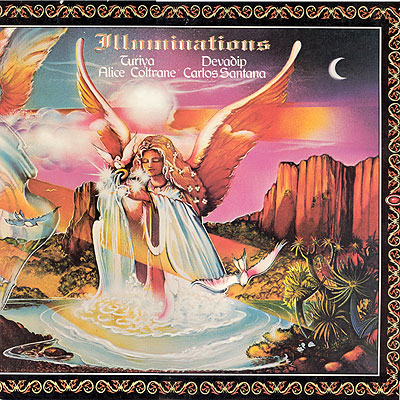
Carlos Santana & Alice Coltrane - Illuminations (1974)


AMG totally slams this record, gives it 2 stars. For me, it's really sublime and beautiful and I bet it would find some fans here. You would think with these two in the early 70s, this record would be really dense and noisy, but it's pretty minimal for the two of them. They are new versions of John Coltrane songs and they sure are pretty.

Of the five albums from Carlos Santana's jazzy period, four can be described as jazz/rock, altho the latter term is sometimes a stretch. Illuminations, Carlos' joint effort with Alice Coltrane, John's widow, cannot be so characterized at all except for one of the four instrumental tracks, "Angel of Sunlight." This jazz/rock fusion, also steeped in raga, is a showcase for the sort of fine guitar soloing expected from Carlos, as well as Santana-style percussion, good bass work, etc. The other three songs are jazz/classical. They are richly textured orchestral arrangements, heavy with sweeping strings arranged by Alice, who herself plays harp and mellotron. Jules Broussard plays flute as well as saxophone. (Where is that Santana percussion section?) Carlos' chief contribution is exquisite, sweet guitar notes, not ripping solos. The result is a majestic, celestial atmosphere, reflecting Carlos' and Alice's spiritual focus of the time. The song titles tell the story: "Angel of Air/Angel of Water," "Bliss: The Eternal Now," and the title cut. This music is not what you normally expect from Santana, but is very pleasant, very lovely, for sure.
-David C. Heires, Amazon.com

Buy Here
Download Here

Sunday, October 5, 2008

Kenny Werner - Lawn Chair Society (2007)


Another recent jazz album. This one is super fun. Out on Blue Note last year, just a nice combination of jazz, funk and weird computerized electro-acoustic sounding mumbo jumbo. Lots of different sounds, but definitely a fun and rewarding listen. And just look at that album cover.

To play jazz, one has to be a complete musician. Requirements: technique, imagination, huge ears, improvisational spark, superb time, and empathy. Jazz is not rife with fakers. As a result, many greats get lost in the fray of musical excellence. Maybe one has been Kenny Werner—and maybe we’ve found him now. Boy, have we.

Aficionados have known him forever. Since the early 1980s, Werner has been playing in fantastic trios, working with the likes of Archie Shepp and Joe Lovano, and becoming a fixture on New York’s jazz scene. I’ve heard him as an intelligent and somewhat indirect player—a guy with a voluminous jazz vocabulary of chords and lines who has neither the blues snap of Wynton Kelly nor the languid lyricism of Bill Evans. But what did I really know? Werner was also a brilliant and deeply rhythmic solo player (check out his set Live at the Maybeck Recital Hall from 1994). Maybe I’d only ever heard a part of his art.

Lawn Chair Society—his first Blue Note record, and his second stint on a major label after a pair of RCAs in the late ‘90s—sets Werner in a new and stunning light. Known as a modern acoustic pianist, Werner does much more than just fool around on a Fender Rhodes on Lawn Chair. Rather, this is an integrated electric/acoustic album that manages not to bury the personalities of its soloists—a rare accomplishment.

The soloists are formidable. In addition to Werner—who improvises only on the acoustic, and with lyricism and wit—the recording features Dave Douglas’s trumpet, Chris Potter on tenor sax and bass clarinet, Scott Colley on bass and Brian Blade’s drumming. Blade brings a unique sound to the disc, never swinging in the straight ahead jazz sense but playing every manner of atmospheric funk pattern, loud and soft, in and out. All the players act similarly as colorists as well as melodists, with Douglas using various mutes and Potter adopting different tones to blend with the electronic environments conceived by producer Lenny Picket for Werner’s compositions. As the players color the pieces, they manage to retain their own voices—Dave Douglas is till piquant and puckish on cornet, Potter jumps and mutters like he is always making a joke, and Colley plays with unparalleled beauty.

Most of the compositions are improved by a well-planned use of electronics. Right out of the gate, “Lo’s Garden” processes percussion through a sequencer of some kind. But rather than being a tune with merely a cheesy fusion-electronica bed, Douglas and Potter (on bass clarinet) play a herky-jerky line that meshes in rhythm and sonority with the groove. Werner’s keyboards are not up front—he always saves the soloing for piano—but they generate pulsations and feeling below the surface. With Colley’s sound always earthy and round, the result is balanced: no fusion flash or smooth goopiness, just a single-minded approach to a fascinating tune.

“Lawn Chairs (and Other Foreign Policy)” integrates acoustic and electric differently but just as well. Though it begins with a hip acoustic piano rip, it then moves into a ragtime-ish keyboard groove that Douglas plays over as if he were some kind of doped-up Louis Armstrong—growling, smearing, and diving for fun with a touch of Miles-ian echo. The two horns then play a line that becomes the ground rhythm as percussion and bass enter. This gradually morphs into a piano solo with traditional acoustic accompaniment, winding up eventually in a Rhodes-and-organ-saturated groove that directly references In a Silent Way. It’s marvelous, however, because each of these transitions is achieved with slight-of-hand. The tune feels complete.

The highlight for me is the astonishingly direct and emotional song, “Uncovered Heart”, written 16 years ago at the birth of Werner’s daughter. The synthesized content is limited to subtle string pads, with Werner playing a Jarrett-like open style that emphasizes rhapsodic melody. After Werner states the simple tune in two choruses, the horns play a variation as introduction to a smashingly plain and lovely bass solo. When Werner solos it is equally elegant and elegiac.

It makes sense that “Uncovered Heart” should be the album’s showcase, as Werner’s daughter, Katheryn, was present for the recording but died in a car accident before the album’s completion. “Loss”, a short, synthesized orchestral piece that likely refers to Werner’s terrible loss, leads the album back to a bass line similar to that of “Uncovered Heart”, which then leads into the album’s only cover, “Kothbiro”. Another highlight, this tune moves with inevitable and stately grace. Werner’s solo is stripped of all clichés, and the trading of statements by Douglas and Potter is the kind of plainsong that jazz always needs more of. Werner—knowingly or not—has created a substantial monument to his love for his daughter.

If I have failed to write about the adventure of Chris Potter in mid-thought or the flash of Brian Blade when he is fused with the piano vamp on “Inaugural Balls”, it is only because Lawn Chair Society is such a thoroughly integrated recording that it tempts the listener to forget its flashiest moments. “Balls” bustles into a brilliant collective improvisation fueled by organ swells and pure Blade hipness. “New Amsterdam” gets started with a Herbie Hancock-ish gospel groove that is jagged and funky at once, with Colley latching it all to the dirt. These tracks are propulsive and meaty just as “Uncovered Heart” and “Kothbiro” are infused with legitimate sentiment. The balance in it all—electronic whooshes meshing elegantly with skin on ivory—is the record’s ace in the hole.

The closer you listen, the higher Kenny Werner’s Lawn Chair Society will rise on your year’s-best list. Firm and delicate, electric and acoustic, gentle and daring, it does with nonchalant ease what 30 years of “fusion” has done so rarely: keep jazz both serious and modern as it integrates the possibilities of new technology. Suddenly, Kenny Werner (along with producer Lenny Picket) is a jazz master and maverick—a veteran artist whose voice has come alive on a big stage.

Pull up a lawn chair and check out Kenny Werner. His time has come.
-Will Layman, Popmatters.com

Download Here

Saturday, October 4, 2008

Esbjörn Svensson Trio - Leucocyte (2008)


I don't usually post new albums, but I thought I'd make an exception today and we'll see what happens.

So i spent a good part of today downloading and looking at some jazz releases from this year because I hadn't really been paying attention. I went to look up what EST had put out this year, only to be shocked that Esbjorn had died in June and here I am 4 months later and didn't even know. Awful. Truly awful to lose such a talent and someone who has been consistently putting out great records and really keeping modern jazz exciting. This trio is basically the biggest European name in progressive jazz in the last few years, and were the first European band on the cover of Downbeat magazine last year, I believe. Anyway, I've liked all the albums I've heard of theirs, but this one blew my mind. The first six tracks are sort of all over the place, but still flow really well. The "Premonition" tracks are great, and the ones that follow are more based in jazz. The album closes with a suite named after the album, and it is experimental and really cutting edge and exciting. A really engrossing record that is out there, but not necessarily by being really loud and abrasive (though it is not subtle either). Definitely one of the best "first listen's" of a new album this year. Highly recommended.

Considering that this is the last we will ever hear from the wonderful e.s.t (pianist Esbjorn Svensson having tragically died in a diving accident earlier this year, at the age of 44) it's impossible not to feel sadness while listening to Leucocyte. Yet it's not for just the passing of one of the world's most talented jazz musicians. It's also for the fact that a band, so psychically linked and at ease with each other should, at this fascinating stage of their development, be robbed of the chance to grow and change as they undoubtedly would have done.

Composed of childood friends Svensson and drummer Magnus Ostrom, along with bassist Dan Berglund, e.s.t's last album, Live In Hamburg, seemed to be drawing a line under the ECM-friendly-with a-touch-of-rock-trio period of their career. Equally at home on the festival as well as jazz circuits, you could feel it was time for a change.

Leucocyte reminds you that, despite carrying the pianist's name, the trio were a band of equal thirds. It's Berglund's earthy tones that drive much of the first half of the album. Following the delicate introductory meditation, Decade, Premonition sounds hungry for just such a change. The feedback and distortion are comparable to Australia's Necks, but under it all Svensson's voice echoes the changes, and his keys can never resist the Jarrett-esque flourishes that trip lightly over the atmospherics. Not once does the soloing take the place of progression and thematic exploration. And the attack always veers towards that rock aesthetic that rears its head most ironically on the number entitled Jazz.

But it's the album's second half suite, Leucocyte, that indicates where the trio were headed next. Mixing in far more electronics; erasing melody, leaving just the warp and weft of instrumental texture, and even (on part two's Ad Interim) resorting to total silence: it shows us a band that were now fearless and confident enough to really experiment.

Leucocyte is far from a perfect album, and that's why it's so heartbreakingly good. It's unsure in parts, and occasionally too wilfully rough. But it's a pointer to a future that's been cruelly denied us. We can only dream of what might have happened next. But thank goodness we have this to remember Svensson by. It's a testament to an artist whose life was always a work in progress.

-Chris Jones, BBC

Download Here
Buy Here

Friday, September 26, 2008

Jerry Garcia & David Grisman - So What (1998)


So from the beginning of the 70s until his death, Jerry Garcia was an active participant (though not usually given his due) in to the "new grass" bluegrass revival scene. Most notable was his friendship with legendary mandolin player David Grisman. The two recorded many records together most of them striking a great calm balance between Grateful Dead and the bluegrass virtuosity that Rounder records was putting out at the time. This record, released in 1998 on Acoustic Disc is a collection of Miles Davis (and Milt Jackson) covers recorded in the early 90s. The disc actually has 3 different recordings of the classic "So What", two of "Bag's Groove" and "Milestones" and then right in the middle of the record is a Grisman original "16/16"

Though the record has little variety in the songs that are actually presented here, the musicianship and the unique takes on these familiar jazz tunes are perfect for fans of new grass and jazz equally. It's a really beautiful and enjoyable cd, with enough funk to get you nodding your head but enough relaxing strings to wake up with again and again. It is a great, unique recording and one of my favorites the duo put out.

Download Here

Monday, April 28, 2008

A To Z: L - Liberated Brother by Weldon Irvine


"I often just sit and listen to him," says Q-Tip, "because he teaches truth. He's my mentor."

In the 4 years since I've discovered Weldon Irvine (and most of the jazz music I have), I have found it strange to find how relatively unknown this man is outside of the hip hop world (and still not even known THAT well there).

If we're talking strictly stream of influence, Weldon Irvine has to be among the jazz greats like Miles and Coltrane and Sun Ra. His soulful electric piano-based albums have been sampled by hip hop heavyweights for years and yet, he is still looked at as a legend.

Liberated Brother is Weldon's first album as a band leader and though it lacks the funk and experimentalism of some of his later albums, what we have here is something so incredibly beautiful and smooth. Throughout the album Weldon takes us on a journey through many different sounds. Whether a slow grooving, meditative piece, or a latin-influenced sound, Irvine does everything to near perfection.

When we get to "Juggah Buggah" we get to hear some fusion and funk sounds, and gives an indication where Weldon's music is headed.

Weldon's music is spiritual in imagery, and would become so later in life as well. He was deeply involved with African-American politics and looked at as a mentor for many of hip hop's biggest names. Weldon is a legend and it is time to take notice.

I'm including a link to a great piece/obituary about him. Really well written and informative:
Nathanial Turner - Weldon Irvine

Download:
Liberated Brother


Thursday, April 24, 2008

A To Z: I - In A Silent Way by Miles Davis


Very few artists will I call undisputed geniuses. Musicians whose contributions to the world at large so greatly influence what we heard after their prominence and what we hear today.

Miles Davis is an undisputed genius.

Much like Dylan in his body of work, Davis is perhaps the most celebrated artist in jazz and also one of the most reviled. Aren't all geniuses?

Whereas contemporaries like Sun Ra, Coltrane and Ornette were about the future, pushing the boundaries of jazz to the outer most extremities, what makes Miles truly unique is that though he is always on the cutting edge of whatever jazz movement is about to happen, he is alway a product of the now. Each album he cuts is a look into the sound that is happening and usually executed better than anyone else could even imagine.

In his immense catalog, In A Silent Way has probably become my favorite recording of his that I have heard (and there is a whole lot I haven't heard). Foreseeing the coming fusion movement, In A Silent Way is an album of unfettered perfection and one of the finest jazz albums these ears have ever heard. As a preface, the lineup is amazing. Playing with Miles we have Wayne Shorter, three of the absolute best keyboardists ever in Joe Zawinaul, Chick Corea and Herbie Hancock and maybe most importantly, the recording debut of John McLaughlin. Here's a review from RYM

Shh. Listen. Calm, Peaceful, Elegant, Graceful. Those are the perfect words to describe the amazing music Miles' packs into just 38 minutes on In a Silent Way, his second greatest album and most accessible gateway to his fusion genius.

The music that graces IASW is perfect, an amazing fact considering the way it's structured. The first side, a single 18+ minute track entitle 'Shh/Peaceful,' consists of vamps and solos. No melody is ever present. All that is played is an unbeatable groove in which Miles and his sidemen-who I'll get to in a minute-solo delicately over.

The same is true for side two, but only half of it. Once again, one side yields one track, except this track is actually a three piece medley with one piece acting as bookends. 'In a Silent Way' opens, 'It's About that Time' follows, and 'In a Silent Way' closes. The title track is so simple, yet so beautiful. Just each musician taking turns playing the melody line, with each one joining at the end. Simple, but oh so lovely. 'It's About that Time' is essentially the same set-up as 'Shh/Peaceful,' featuring more great soloing and what may be the most infectious groove known to man. The whole album is so simple on the surface, but so amazingly complex below it any fan of any music can appreciate it.

The musicians Miles works with are incredible, as is the format they inhabite. The band is Miles on trumpet, John McLaughlin on guitar, Wayne Shorter with his debut on Soprano Sax, Herbie Hancock & Chick Corea on electric piano, Joe Zawinul on organ, Dave Holland on bass, and Tony Williams on drums. You read that correct. In a Silent Way features THREE piano players. The sound of that makes all the music I wrote about sound idiotic, but trust me, it's not! What seems to be muddled, messy music is actually organized, pronounced, and defined. The three keys work effortlessly around eachother, with Hancock and Corea brilliantly trading off runs while Zawinul juts in and out. They really create the back drop over the rock steady rythm of Williams and Holland that makes the music so awesome.

The soloing is stunning. Miles never sounded better. His phrasing is lyrical as ever, his tone beautiful, and his dynamics are incredible. McLaughlin is just as good. In his first recording EVER, he follows both the path of Zawinul and is his own soloist. He juts in and out, and finally gets his own opportunity to solo away, experiencing a serenity never heard on his Mahavishnu Orchestra recordings. Wayne Shorter is every bit as good. Though his main ax is tenor, he is still quite good on Soprano, and his lines are lyrical, precise, and oh so soothing. The delicate soloing on In a Silent Way only further accent it's calm nature.

It really is amazing. How such an unorthodox line-up and such a sketchy plan can produce such beautiful music is simply a testament to Miles Davis the visionary. Every second of this music screams genius at the top of it's lungs, and every precious note played displays perfection. This album is silent. And silence is the sound of brilliance.

Download Here:
In A Silent Way